Showing posts with label Trivia. Show all posts

Wednesday, 11 May 2016

Downton Abbey and the History of Clean Hair

I confess that we watched the final season of Downton Abbey when it played in Britain last year. We streamed it using a proxy server, which is WAY beyond my technical prowess, and if my husband were not also a fan of Maggie Smith, I doubt I would ever be able to watch it, because we don't even have cable.

Without giving anything away, I feel it is safe to say that in the Christmas special finale, many things of significance were done and said, wrapping up a long, soapy story. But the one I picked up on, the one that made me want to write a blog post, was a little, forgettable, off-hand remark made by Molesly of all people.

He said to Baxter, as they were walking in the village, that shampoo was actually Indian, that the Indians had it for centuries before the English. This is just the sort of tidbit that Julian Fellowes likes to drop for us nerds to catch, and it reminded me of a few tidbits I have come across in my own research, and which lead me to hypothesize about how India changed the face of English fashions.

Mr. Molesley was, in part, absolutely right. The word shampoo comes from the Hindi word meaning massage. So if, in your Regency reading, you encounter people talking about going for a shampoo, they were likely going to an early massage parlour, or Turkish bath, where such things were purveyed. The idea was first brought to England by one Sake Dean Mohamed, who was appointed the "shampooing surgeon" of George IV as well as William IV.

The hair-washing type of shampoo was at one time made from soap nuts, or so I have read. My first encounter with soap nuts occurred as a result of cloth-diapering my first-born. Soap nuts are recommended as a natural washing agent that will not leave residue and make the diapers smell. They are the fruit of a tropical tree and, when agitated in water, release their waxy coating in a sudsy froth that dissolves oils and cleans things. They have been used in India since well before Regency times, both for laundry and for personal cleanliness, including washing hair.

This is what raw soap nuts look like. You really can just throw a couple in the wash with your clothes. They do work.
Body soap in the Regency was made with lye and would have been quite harsh on hair, I imagine, though I have never tried it. I have also never tried modern soap on my hair. Generally, it all seems like a bad idea. Also recommended during the Regency for hair washing, was to apply beaten egg whites to the roots of the hair, leaving them to dry and then rinsing them out. While this may have been effective, it smells terrible! And not amount of rinsing can get rid of that acrid odour. Soap nuts, unlike soap, are very gentle, but like eggs, smell awful.

So, Regency ladies would have their hair washed with a solution either made from the liquid in which soap nuts had been  boiled, or into which soap had been shaved and dissolved. To this liquid were added essential oils and herbs and probably vinegar. (My grandmother has always sworn by the efficacy of a vinegar rinse for making hair soft and shiny and manageable.) The herbs and oils may also have benefited the hair, but more likely covered up the wretched smell of the soap nuts, which really do smell HORRIBLE when you boil them. And they would not have used it in the way we use shampoo, just rubbing it into their hair. It wouldn't have worked. They would have agitated it and then taken the foam and worked it through the hair. It would have been quite an undertaking.

The point I am attempting to make is that shampoo as we know it did not really exist in the Regency, or even in India. So, sorry Julian Fellowes, but even the word "shampoo" was not used to describe liquid, hair-washing preparation until the Edwardian era, which really saw the flourishing of commercial products of all kinds. So it would not have been any sort of surprise to Baxter, hearing the fact in the 1920s, that shampoo had not always been part of English life.

Early Edwardian shampoos
Non-soap-based shampoos, made instead with chemical surfactants, were not produced until the 1930s, and that is what we all use now. And let me say that for all my love of history, I am very glad not to be living in it. Shampoo as we know it is so much more effective and user-friendly than any soap nuts liquid. Believe me. I have tried both.

Monday, 9 May 2016

Football banned in London due to player deaths and property damage

As you might have guessed, this is not current news. My book is about the past, and so are all my posts. This actually happened in the 14th Century, but it did happen. So if you think football has only gotten out of hand in recent years, think again. People were regularly killed, maimed and injured in inglorious ways very regularly right through Jane Austen's time. People would sometimes get stabbed, or break their shins against each other, or break each other's heads. It was very violent. That's why it was banned in London in 1314. It was also banned in Manchester, but you can imagine how that went over.

For the benefit of North American readers, I should clarify that I am talking about the game now known as soccer. It was not called soccer until the late 1800's, well after Jane Austen's time, but although the word is mostly used in North America, it is most definitely an English invention. (My apologies to those who already know all this stuff. I only found it out in recent years, and finding it myself quite interesting thought I might as well share it.)

The game was always called football, and in fact, American football derived from it as well. In New Zealand we called the American sport Gridiron. This apparently has to do with the lines on the field. Everyone there played Rugby, which also derived from the same sport and is named for the school where the rules were codified. Rugby school was very posh, and so the game is thought of as more upper-class, though it has the same roots. The game we call soccer is Association Rules Football. The Association was formed in 1863. Association is shortened to Assoc. and as the English have this charming way of putting "er" on the ends of things to make them chummy, they called it soccer. They also do this with rugby, call it "rugger."

From what I have read, it seems like the sport mostly started in the north of England. It was played in medieval times between neighbouring towns, on Sunday, when folks weren't working. The teams were formed out of the trade guilds, especially the young apprentices. The older men would ride out and cheer them on. Imagine Darcy and Bingley, of an afternoon, on their mounts, cheering for the Lampton blacksmiths in the paddocks of Derbyshire.

The match would start in the middle of a field halfway between the towns, and each town would try to get the ball to the other town's church door, which was the goal. I don't know about you, but I think this is fascinating It sounds a bit more like capture the flag to me than what we think of as football.

The fact that teams were traditionally formed out of natural trade associations is the reason I support the team Crystal Palace. I say I support them, but that just means that when someone asks me, I say I support Crystal Palace. That team was formed by the workers who built the Crystal Palace. If you don't know what that is, perhaps I will do a post on it another day, even if it was actually Victorian.

Thursday, 5 May 2016

6 words that make you sound like Jane Austen

If you ever fancy trying your hand at writing an Austenesque story or dialogue, or if you just enjoy using historical language in your every day speech, it can help to have a few key words and phrases in your back pocket, to give it an authentic flair. These are just a very few that I like, to get you started, vocabulary that has fallen out of use, or at least have changed in their use since the early 1800s. I referred to "a want of evidence" in a legal submission recently, and thought it made me sound very distinguished. Let me know how you get on with using them, or if you have a particular love of your own antiquated colloquialisms.

Haste - meaning quick speed, or rapidity as it were. You can tell someone to hurry by saying, "make haste!" Or you can do something hastily, often to your regret. Or you can be hasty. It is a terrific word, and very efficient, for in one syllable there is so much mood and subtlety, I feel.


Alacrity - meaning enthusiasm and haste (see above). This word is quite common in Jane Austen's writing, and we NEVER see it any more. I have only ever seen it as a noun, though if anyone knows its adjectival form, please do share!

Vast - meaning very, very large. It can be used simply to describe a physical thing, such as the most common example of a vast ocean. You can also speak of there being a vast deal of something, which is very Jane-Austen in my opinion. And you can use it as an intensifier, such as being vastly disappointed in the shocking want of cake.

Directly - meaning immediately. We still use this word, of course, but not quite in the same sense. Think of Mr. Bingley saying, "I shall speak with the solicitor directly." You can also use it to replace the phrase, "as soon as," as in, "I shall ask him directly he comes here." This sounds very awkward to our modern ears, but that is what makes it authentic.

Parched - meaning thirsty. Actually, in some places they still use this word, like Newfoundland, for example, which actually has the oldest form of English currently spoken in our modern world - at least according to Trivial Pursuit, or some board game I once played that had that as a question. It's some hot today, byes! I'm right parched.

Want - meaning lack. I wrote a whole post on this word, so I was not going to include it, but decided to at the last minute because, being quite a common word, it comes up a lot and, in my opinion, makes a vast deal of difference to the sound of writing. If you don't have any tea, for example, you can speak of a want of tea. It doesn't necessarily mean you want some tea, though. If you don't have tea, and you want some, you can say that you want for tea. See how exciting this little word is? So much style, I feel.

So make haste, and come with alacrity to my vast offering of tea, directly I call you, for I see you are parched and want refreshment!

Monday, 2 May 2016

Dressmakers: unexpected feminist revolutionaries

When I was writing Mary Green, I wanted to have a character who was a mantuamaker, and I wanted the dressmaking to be a bit of a feature in the book. I had to do a bit of research about how one went about ordering gowns, and I discovered, rather by accident, that dressmaking, or mantuamaking, has quite a bit more to do with the history of feminism than I had bargained for. This was particularly problematic because I wanted my mantuamaker to be male. I wanted him to be handsome and charming and a bit of a dark horse, which was tricky once I understood how important this trade was for women.

Check out this ENORMOUS mantua, circa 1744, from the
Victoria and Albert Museum.
I discovered that, until the 17th Century, it was illegal for women to make and sell clothing, both male and female. (I have not been able to find the actual legislation which restricted economic activity to men, but believe it did exist. If anyone has a source for this law, please do direct me to it.) Then, in the mid to late 1600s, a new fashion came on the scene that would forever change the course of women in the workplace.

It was called a mantua, or a manteau, or mantle, and because of its construction it fell outside the prohibition. It was a loophole in the law, and it opened the gates to allowing women into the industry. The mantua was a less structured garment than the gowns of the previous era. It was worn over a structured stomacher and petticoat, and because of its lack of boning was somehow permissible for women to make and to sell. And once they were in, they did not let go their hold. They were the ultimate entrepreneurs and they weren't going anywhere. In fact, they branched out into millinery and jewellery and other associated trades.

And do not think that there was no push-back from the tailors! The gentlemen of the profession continued to make men's clothing, as well as stays and corsets and outerwear for women, as these tended to be more labour intensive and required more physical strength. But they lost their foothold and their ability to argue that women could not do the work of making soft-flowing robes.

Dressmakers Shop - 1775
The matter was hotly debated in parliament even, with the guilds arguing that these women were taking work away from men who had to support their families, failing to mention, of course, that women without husbands had no other means of supporting themselves and their families. Arguments were raised, even, as early as the mid-1700s that permitting women to enter into commerce in this way was was opening the gates to such horrors as women gaining the vote or standing for election. This slippery slope argument was dismissed as an absurd level of hyperbole and the women were left to earn their keep. And as the late 18th Century saw the advent of very unstructured gowns, chemises really, the mantuamakers came to be the fundamental clothiers of society ladies.

Up until then, the men were still a real part of the game, though not everyone thought they should be. Fanny Burney, for one, wrote of them as unnatural fops, knowing more about women's bodies than women did. She was writing in the second half of the 18th Century. By the early 19th Century, there were virtually no male mantuamakers left. I read on one blog that by 1810, there was not a single male dressmaker in all of New England, so that is something. However, I did find support for the idea that there were a few male mantuamakers about in England at that time, though they were rare.

My dilemma was that I wanted my lead character, Mary, to be snubbed by the high-end, popular dressmakers of Pall Mall, but not by the humble guy in the shop off the high street. I did not like the idea that these ladies, who were fighting tooth and nail to keep the men at bay, who were feeding their families with their own labour, would snub poor Mary Green because of the state of her shoes, while a man would be humble and kind.

In the end, I resolved to make my dressmaker, Mr. Graham, a linen-draper whose mother had been a dressmaker and who had learned the trade from her, since she did not have any daughters. In the later years of his mother's life, he was doing most of the work as her eyes and hands began to fail her. Linen-draping (or selling fabric) was a separate, male-only trade, though very occasionally, a linen-draper would have an in-house dressmaker. Consequently, it is the snobby, male linen-drapers who turn their noses up at Mary, and Mr. Graham who trusts her to bring his fashion skills to the ladies of London.

I hope you will like him as much as I do, and that you will not blame him for being male. Perhaps, if he is successful, he will give employment to many deserving women, and who knows? Maybe his daughters, or grand-daughters will one day fight for the vote, in memory of old Mrs. Graham and her determination and ingenuity.

Thursday, 9 April 2015

What would Jane Austen eat for breakfast?

The answer, tea and toast, is not very interesting I grant you, but the rise of the tea and toast breakfast, at least in my opinion, is.

You see, not long before her time, the usual breakfast of English champions was the famous Beef and Ale breakfast. Yes, that's right, beef and ale for breakfast. Appetising right?

In my post about death by teeth, we learned about how the English loved their sweets, but they also were renowned for their love of meat. The French called them a country of flesh eaters. They mostly lived off meat and cake.

As for the ale, well, it was weaker than the beer we drink now, quite watery in fact. Until they started drinking tea, the English pretty much didn't drink anything that wasn't at least a little bit alcoholic. This is because alcohol cleans the water, so adding a little makes things safe to drink. Water was not considered safe to drink on its own, and it probably really wasn't. I have heard a theory, which makes a good deal of sense to me, that the real reason Bath was so effectual at curing certain illnesses is because people "took the waters" there, from the spring. It was reputed that it contained healing properties. Perhaps it did. But it was also the only water they drank. And they were often prescribed it in rather large dosages. For a people who lived on meat, sugar and alcohol, this alone was probably sufficient to address many of their ailments.

You will recall Mr. Woodhouse, in Emma, drinking wine and water, which was considered a very mild drink. Ale was particularly popular because you could grow grain in England, and therefore it was in ample supply. But tea was another story.

We think of tea as quintessentially and eternally English, but if you think about it, that can't possibly be true. As you might guess, tea doesn't grow in England. There is a woman in Victoria, Canada, who is starting to grow tea, but it is very weak and will take generations to develop into something drinkable, and may never be any good because,although Victoria is the warmest part of Canada, it is still really too cold for tea.

In England, I am not aware of anyone even attempting it. But those cheeky colonials got away with claiming for England lots of other countries, and with them all their resources. As the British Empire expanded into the East, the English were introduced to tea. In later years, they would go to great lengths, including devastating wars, to keep their tea supply flowing.


The excellent benefit of tea was that it required the water to be boiled, making it safely drinkable. It was VERY expensive and consequently became very fashionable. By Jane Austen's time, it was indispensable. See my post about tea, to read about just how valuable it was.


There were, however, those who did not think tea was right for England, crotchety old men who thought beef and ale was perfectly good for their ancestors and should be perfectly good for everyone else - none of this foreign, new-fangled tea business coming in and taking over the good, old-fashioned English ale. Some said tea was bad for the health, citing the change in the complexion of young ladies as evidence. Tea has taken the blush right out of their cheeks, they said. Never mind that it was not the tea taking it out so much as that the young ladies were no longer in a constant flush from being ever so slightly drunk.

Having abandoned their beef at breakfast time, the English clung to their cake. With their tea and toast they also ate pound cake, and lemon drizzle and various other sweet baked goods. They also drank cocoa. This was probably the healthiest thing they ate. Cocoa at least has some antioxidants. And they didn't at first take it sweet like we do. Cocoa was initially a watery, spicy drink, not at all the sweet, creamy thing we have with marshmallows around the fire. They may also have eaten chocolate, but I cannot confirm that. And I very much doubt Mr. Woodhouse would approve if they did.

Melanie Kerr is the author of Follies Past: a Prequel to Pride and Prejudice

Read Chapter 1      Watch the Trailers      Buy the Book

Wednesday, 8 April 2015

Studies have shown, Queen Victoria lived for almost a thousand years

The manor house which my brother, to his eternal
shame, unwittingly referred to as a cottage
By studies, I mean the vernacular of colonials. I have long noticed, to my great amusement, that for North Americans at least, the word "Victorian" refers to anything predating the First World War. I have heard many such charming remarks as, "I love Downton Abbey, especially the Victorian costumes" or "When you go to the Jane Austen festival, do you wear Victorian dresses?"

I do not wish to be like that English woman who bit my brother's head off for calling the stone manor house a cottage, but I thought I might just clarify a few things in case you don't know. I assume most of you do know, in which case, I write this so that you have something to which you can direct people when you haven't the time or the inclination to tell them why they don't love all that Victorian stuff in "The Tudors."

Also, I have been organizing a lot of Regency events lately, like the Springtime Ball advertised on the right (you should totally come), and an explanation of what is meant by 'Regency' may be useful.

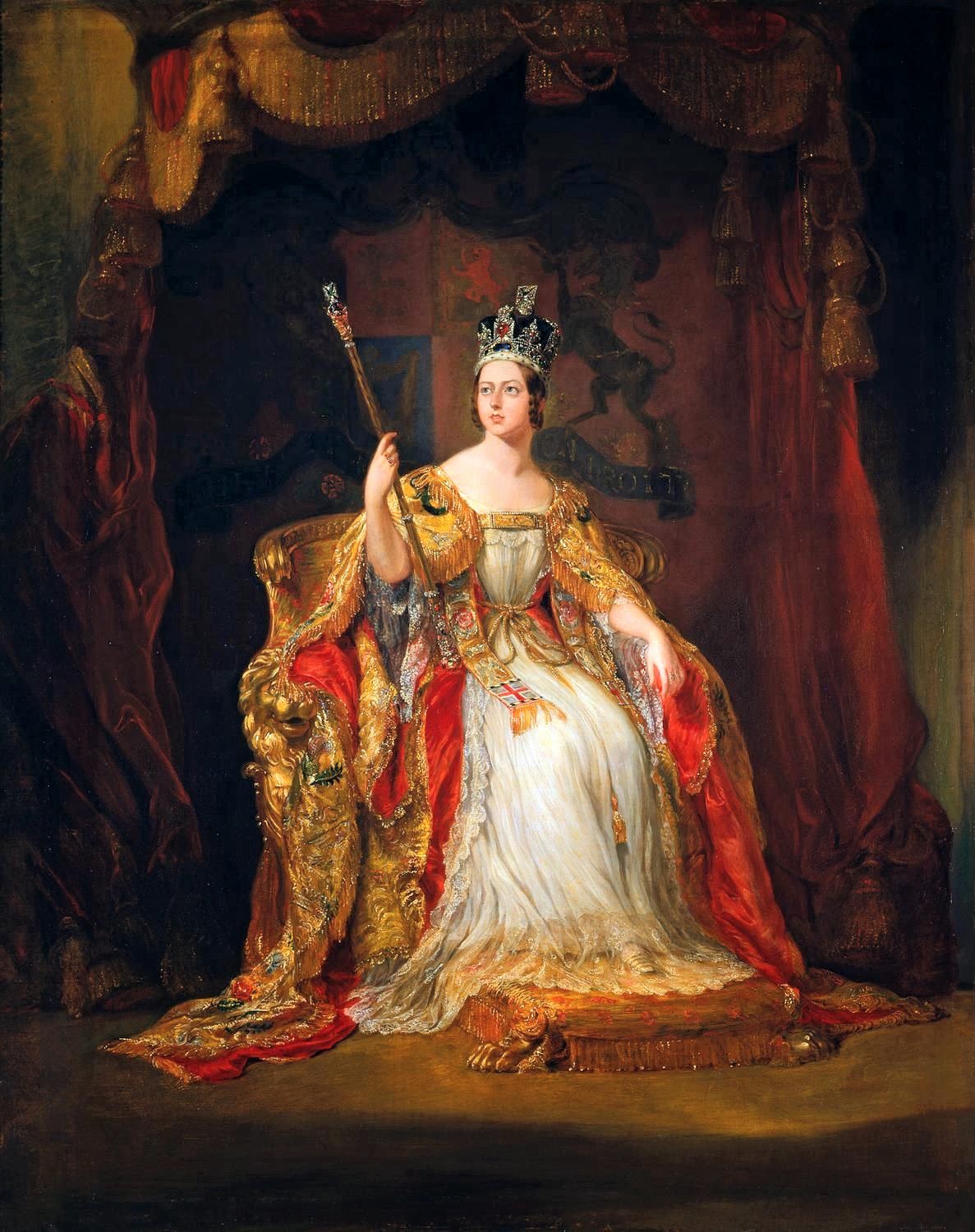
Young Queen Victoria at her coronation in 1837
Eras in English history are mostly named after the monarch reigning at the time. The Victorian era refers to the time when Queen Victoria ruled England. She became queen in 1837, aged 19, marking the beginning of Victorian England.

She died in 1901, at the age of 83. The intervening 64 years only are what we can call the Victorian age, or era. Nothing before, and nothing after.

Hers was the longest reign in English history and, I grant you, a long time for any single monarch, so it is somewhat understandable for people to think it covers pretty much all of the olden days. Furthermore, the Victorian era was remarkably prolific, particularly in terms of literature and technology, so much so that we who are so far removed from any other knowledge of England's history think that everything ever produced in the olden days, must be Victorian.
Queen Victoria near the end of her reign

Downton Abbey opens with the sinking of the Titanic in 1912, which is, at best, the Edwardian era, though King Edward himself was actually dead already, as of 1910. His son was on the throne, so that is really two monarchs removed from being Victorian.

Jane Austen's works were published in the second decade of the 19th Century. Jane Austen herself died in 1817, 20 years before Queen Victoria took the throne, and in fact, a year before she was even born. The era we associate with Austen, and when all her books were published, is called the Regency, though you may have heard me refer to it as the Georgian era. Allow me to explain.

There were several kings in a row who were all called George, and their collective reign is therefore known as the Georgian era, or period. The first of the Georges became king in 1714. The third one, George III, was on the throne when he started to become mentally ill in the late 1700s and early 1800s. They made an excellent film about it called "The Madness of King George." It was going to be called "The madness of King George III" but the producers thought American audiences would not go see it because they had not seen the first two movies in the trilogy. God bless America.

King George III had a son who was also called George, specifically Prince George. In 1811, George III was declared unfit to rule and his son took over, but not as king - as Prince Regent. A regent is someone who rules in a monarch's stead while that monarch is unable for some reason. This sometimes happens when a child becomes king or queen. The monarch is a figurehead only, and a regent is appointed to do the actual job of being in charge.

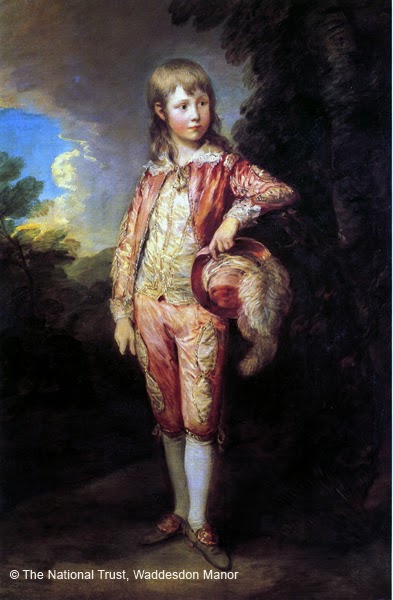
A young prince George, most likely before his Regency,
though I could not find a date. Please comment if you know
when this portrait was done.
Prince George ruled as Regent from the age of 39, in 1811, until his father died in 1820, at which point the Prince Regent became the King. Those nine years were and still are aptly called the Regency. It is, however, still correct to call it Georgian, or late Georgian, as the prince was after all a George, and became King George IV, extending the Georgian era until his death in 1830. Some include the subsequent reign of his somewhat under-appreciated younger brother, William, as part of the Georgian era, and that takes us right up to 1837 and the reign of his niece, Victoria.

If you watch the film "Young Victoria" you might discover that she was pressured to allow someone to rule as her regent when she inherited the throne, but she refused. You may also be falsely led to believe she looked something like Emily Blunt, whom I adore, but who really is so lovely, one could be deceived into thinking Queen Victoria was a beauty. I assure you, such was not the case.

So, now you know that the stuff you love in "The Tudors" is Tudor, and everything in "Elizabeth" is Elizabethan. And if you don't know, or don't particularly care about the exact historical period, you can always just call it old.

Melanie Kerr is the author of Follies Past: a Prequel to Pride and Prejudice

Read Chapter 1      Watch the Trailers      Buy the Book

Tuesday, 24 February 2015

Cinderella and the Glass Slipper

On March 13, Disney releases its new re-telling of this classic tale.  As an unabashed Disney fan, I look forward to it with great anticipation. Also, I love alternative re-tellings (Wicked, Maleficent, etc.) I hope to go on opening night with a large group, either in costume or in pyjamas.

I thought this would be a good time to air my beef with Stephen Fry. Well, I suppose he just reads the cards the QI elves give him, but whenever he says something wrong, I feel I have to dispute it at least to my readers. Please note that I actually adore Stephen Fry and his show. I'm just a bit uppity and excitable when it comes to historical trivia.

In one episode of QI, Mr. Fry states that Cinderella never wore a glass slipper, that this was a translation error and that the slipper was made of squirrel fur. This, he suggests, is because of the homophony of the words "vair" and "verre" in French, the language in which the most popular version of the story was first written. Note that this is the version on which is based the Disney cartoon film, which is (surprisingly for Disney) really rather faithful to the tale on which it is based.

I did a bit of research on this question, and I am convinced that Mr. Perrault, who first included the glass slipper in his telling "Cendrillon" in 1697, intended that it be a glass slipper, not a fur one. Here are my reasons, for your consideration:

1. The word in the story is written "verre." It appears numerous times in the story, and is always spelled this way, which means "glass." It never appears as "vair" or "fur."

2. There is no evidence Perrault did not know how to spell. He does not have a history of confusing the spelling of words with their homophones. By all accounts he was a very learned and erudite guy. Although spelling in the 17th Century was more flexible than it is now, there is no evidence that I am aware of that "verre" was ever an acceptable orthographic variation of "verre." Furthermore, where multiple spellings are acceptable, one usually finds that the word is spelled in different ways within a particular manuscript. Jane Austen, for example, uses both "friend" and "freind" in her books. Only "verre" is used by Perrault in Cendrillon.

3. I have not been able to find any contemporary illustrations for the Perrault story, but at least this one, done in 1862 by Gustave Dore (there should be an accent aigue above the "e" but I can't do one in this program), shows what looks to me like a glass slipper, suggesting that  at least19th Century folk, in France where Perrault first wrote and published his version of the story, believed it was made of glass.

4. One of the reasons for believing that there was a confusion between "vair" and "verre" in this story is that it seems ridiculous to have a slipper made of glass, whereas a slipper made of fur makes perfect sense. Need I remind these people that this is a fairy tale? Everything about it is ridiculous. They make a carriage out of a pumpkin. Perrault was renowned for his creativity. He was practically (though not actually) the founder of the fairy tale as we know it. There is no reason to exclude the possibility of a certain element of a fairy tale because it is fantastical. See my reasons below as to why glass actually makes more sense than fur.

5. The qualities of glass fit the story. Glass, in the 17th Century, was very precious. In the Grimm version of the story, the slipper is made of gold, reinforcing the notion that it was made of a precious material. Furthermore, the very fragile nature of glass fits the ephemeral idea of magical garb that lasts only one night. Also, any lady wearing a slipper of glass must be very graceful and dainty, or they will break the slipper. This implies that Cinderella was all these things, which is consistent with the nature of her character. Unlike fur, glass has absolutely no give. It does not stretch. It would have to mould to the foot in order to fit. Given that only Cinderella can fit the slipper, it makes sense that an inflexible material, like glass, suits the plot of the story better than fur, which might stretch and bend to fit another lady's foot.

I don't know whether I have convinced you or not, or whether the elves at QI might ever reconsider their position, but this is how I came to my own conclusion about the glass slipper. I hope the new Disney film delivers, and is at least as entertaining as this blog post!

Some of my favourite people, on the set of QI, in fitting costumes for the subject of Cinderella


Melanie Kerr is the author of Follies Past: a Prequel to Pride and Prejudice


Monday, 9 February 2015

Mr. Darcy was actually a plumber

Well, maybe it would be more accurate to say he was a pipeline engineer. My brother is also a pipeline engineer, and when I asked him about this, he acknowledged that, indeed, Mr. Darcy is integral  to pipelines everywhere.

I do not, of course, mean Fitzwilliam Darcy, of Pemberley, and indeed, the character was created before the engineer became known. It is just a bit of trivia to get your attention. But something I did learn at a talk by Beatrice Nearey at the Edmonton Library, is that there was running water in London in the time of Jane Austen, which I found surprising.

I recall watching the Forsyte Saga miniseries in 2003 (which, by the way, is possibly the best miniseries ever made and stars Damian Lewis in possibly the best performance ever given, making me resent that his rise to fame came from Homeland when I had been singing his praises for over a decade. Also, Homeland is excellent and I really like it, but I only watched it because it has Soames Forsyte in it.)

There is a scene in which the character Irene goes into the bathroom, gets in the tub and turns on a tap.

When I first saw this, I wondered about the historical accuracy of a Victorian having running water. It seems it was not only possible but quite likely. By the late Victorian period in which the book is set, Mr. Darcy had long established his pressurized water system in France. And Soames Forsyte was a man of Property and lived in Montpelier Square, which was quite posh.

At one point, water was piped in to London from Hertfordshire through the hollowed-out trunks of trees by the New River Company. I wonder how this could possibly be effective, but I am told it was done. The water only went to the most well-to-do houses, such as those in Montpelier Square, and ran for a total of 24 hours per week.

By Jane Austen's time, there were several water companies, such as Chelsea Water Works, distributing water in London. Normal people got their water from the Thames through a distribution system that was, at least at one time, made of lead.

At one point along the New River, the water was used to flood a large theatre for something called Aqua Drama, or Aquatic Theatre. This was a sort of entertainment in which naval events were staged on massive water tanks for the enjoyment of the paying public. They had actual ships made by actual shipbuilders, albeit on a smaller scale, but that were actually capable of firing real guns - inside the theatre. I do not know if anyone was ever killed in these enactments. It would not surprise me. The idea came from the ancient Romans, was revived in Medieval England, and apparently returned again to amuse the Georgians.

Aqua Drama in action

Melanie Kerr is the author of Follies Past: a Prequel to Pride and Prejudice


Read Chapter 1      Watch the Trailers      Buy the Book

Wednesday, 22 October 2014

Jane Austen's family probably called her Jenny


When Mrs. Austen sent a letter announcing that they had had a girl, she added, "and we shall call her Jenny." From this, I conclude, that is probably what her family called her, at least some of the time. Perhaps not. Perhaps they thought of her as a Jenny when she was little but it didn't stick. Nicknames are like that in my experience. You can't always say what they are going to be. Still, I like to think of Jane Austen being called Jenny in an endearing way by her mum, and maybe others in her family. It brings her to life in my mind anyway.

We don't usually think of Jenny as a nickname for Jane. Most people think of Jenny as a nickname for Jennifer, but that is a recent invention, as people didn't used to be called Jennifer, generally speaking. I also know that Jenny was used as a nickname for Jane because my great-great-grandmother was called Jane, and she went by Jenny.

Anna Maxwell Martin and Anne Hathaway as Cassandra and Jane Austen.
Think of me what you will; I love this movie.
Although people in public used to call each other "Miss such-and-such," and not just their first name, or Christian name as it was then called, younger, unmarried sisters still heard their names used a lot in public. Only the oldest unmarried sister (in this case Cassandra Austen) would always have been called Miss Austen. Jane Austen would have been called Miss Jane Austen, or simply Miss Jane by closer acquaintances, unless her older sister wasn't there, in which case she could be safely called Miss Austen without any confusion. The Bennett sisters were Miss Bennett, Miss Elizabeth Bennett, Miss Catherine Bennett, etc. The Dashwood sisters were Miss Dashwood, Miss Marianne Dashwood and Miss Margaret Dashwood.

I don't think Jane Austen would ever have been called Miss Jenny, at least not in public. The mix of formality and familiarity does not seem right to me, but if you have differing information, please put it in the comments. I could be wrong. Elizabeth Bennett is sometimes called Miss Eliza, but never Miss Lizzy, except by her mother.

Speaking of nicknames, the word "nickname" has an unexpected origin. It actually began as a bit of a mistake, as so many words do. Originally it was "ein ickename" meaning "an other-name" but the "n" got stuck to the beginnig, so we started saying essentially "a nickname" instead of "an ickname."

We begin to see this same process happening with the insertion of words into phrases using "another." You might hear people say, "that's a whole nother thing," and the like. I decry this, but what can you do? Perhaps someone centuries ago was decrying the nickname.

Melanie Kerr is the author of Follies Past: a Prequel to Pride and Prejudice

Read Chapter 1      Watch the Trailers      Buy the Book

Tuesday, 17 June 2014

Did old Mr. Darcy kick his tenants off Pemberley in 1773?

You may not find this terrifically amusing, but I thought I would write about it because it was terribly significant and I had never heard about it before I started researching my book. I feel particularly driven to set the record straight after Clive Anderson appallingly misrepresented the facts on QI. I am going to use Mr. Darcy and Pemberley for the purposes of illustration. It is particularly convenient to do so since most of this happened in the North.

Pemberley was a vast estate with huge tracts of land. Mr. Darcy did not work the land himself. He was a gentleman. Instead, he had tenants to work it for him. In return, they got to live on the land in cottages owned by the Darcy family. They also got to use the common lands for their own sustenance. This is where I think it gets interesting.

A portion of Pemberley's lands would have been set aside as commons and would not have benefited the Darcy family at all, well, not directly at least. The tenants would have had a system for dividing up the land and allocating it amongst themselves from year to year to grow crops for their own families. In addition, some of the land would have been for grazing, and each tenant would be allowed to graze a certain number of cattle, sheep, chickens, etc. on that land for their own use. In fact, there are some places where this system is still followed. At least there is one. I saw a program about it on the BBC.

This system was in place from at least the middle ages. All estates had common lands and that's how the system worked and how people survived. We know this as feudalism. As early as the 1100s, however, people started chipping away at the system. Landowners started enclosing the common lands, and taking it for their own use. This was not very popular with the peasants, obviously, and even led to riots in Tudor times.

Clive Anderson said the lands were public and that the rich people just came along and took them for themselves. This is gross error, and as a former barrister, Mr. Anderson should know better than to make such misrepresentations to the public. The land always belonged to the rich people. It was just set aside for the use of the tenants of the owners. And they didn't just come along and take it; there were acts of parliament which authorized the taking. That said, it was still shocking and terrible.

In the 18th Century, methods of agriculture became more efficient, and the number of peasants required to work the land decreased. By the latter part of the century, there were wars in France and embargoes on grain. His Majesty had armies to feed, and not enough bread. It became very important to the common good that landowners produce grain on their land as much as possible. These forces were impetus for parliamentary Acts of Enclosure. Under the Common Law, you couldn't just take away people's rights to use the common lands. There had to be legislation removing those rights. And there were little local acts going back to the 12th Century. But in the late 1700s, there began to be national ones, with a consolidating act in 1801 to tidy them all up and make them into one.

Mr. Darcy was considered by Mrs. Reynolds to be the best landlord and the best master, so he probably didn't do any inclosing. His father might have, but then Mrs. Reynolds says Mr. Darcy is just like his father, so that seems unlikely. Perhaps Pemberley remained under the old system until the Victorian era, specifically the 1840s and 1850s when another spate of enclosures took place.

I actually read one of the inclosure acts. It allowed landowners to enclose the common land, but they must compensate the tenants with other land somewhere else. This, of course, was not generally followed. The peasants were just kicked off the land and the landowners kept a few people around to tend the fields in a more efficient manner on a large scale and got rich and fat.

All these peasants moved to the cities trying to find work, or squatted and poached in the countryside. It was probably displaced peasants who stole Mr. Woodhouse's turkeys. This migration to the cities, and general abundance of unemployed people is believed to have catalyzed the Industrial Revolution. There was a ready supply of thousands of people to fill up the factories and the coal mines, which there would not have been had everyone been happily tending their little strip of the commons and grazing their sheep in Pemberley's rugged meadow.

Melanie Kerr is the author of Follies Past: a Prequel to Pride and Prejudice

Read Chapter 1      Watch the Trailers    Order Paperback      Download eBook

Wednesday, 11 June 2014

The thorn in Ye Olde Pemberley is gone

I promised someone I would do another language post, and since the Great Vowel Shift garnered so much attention, I thought it not a bad idea. I will refrain, however, from going off on Grimm's law and the rise of the intervocalic fricative, however sorely I am tempted.

My subject today is one that has caused me to jump out of my seat, twice, and scream excitedly at Stephen Fry, on the set of QI, through the screen, because I knew the answer, and I was so wretched at not being on the show at the time... not that I have ever been on the show, but, you know, I have aspirations. And those of you who know me well understand how unbearable it is for me to be thwarted in demonstrating my awkward trivia knowledge.

The question related to the word "Ye" as in "Ye Olde Tea House," or other such "Ye Olde" things. The question was how to pronounce it and why. I started jumping up and down screaming, "it's a thorn! It's a thorn!" Then Stephen Fry, in an infuriatingly calm voice, explained how the "Y" was not a "Y" but a thorn.
The thorn is a lovely little old English letter which looks kind of like the Greek letter phi, in the lower-case. It is pronounced as an apico-dental fricative, like the "th" at the start of "the." It can also be voiceless, like in "Thursday." It was pretty much out of use by Jane Austen's time, but she would have known how to pronounce it I expect, as her family was very literary and educated.

This charming letter did not make it into the printing press, and was represented instead either by a "th" or by a "Y." But it was always pronounced the same. "Ye Olde" is and has always been pronounced "The Olde" and was never anything else. I give you license to correct anyone who says otherwise.

As an aside, you will notice that only grammatical words and no lexical words begin with the voiced apico-dental fricative. Feel free to display your own geeky knowledge by explaining in the comments section what I mean by that.

Melanie Kerr is the author of Follies Past: a Prequel to Pride and Prejudice

Read Chapter 1      Watch the Trailers    Order Paperback      Download eBook


Monday, 9 June 2014

Jane Austen thought boys should wear pink


She was not making any challenge to gender stereotypes and she was not at all alone in her opinion. In the old days, pink was considered a boys' colour and blue was for girls. Pink is a shade of red, which was thought to be masculine and strong; whereas blue was considered delicate and soft and feminine. My sole authority for this is an episode of QI, so if I am wrong, I blame that program entirely.

Apparently, this was the case until the 20th century. Stephen Fry shared a story about a princess in Belgium, I think, in the 1930s who had painted her nursery blue in anticipation of having a baby girl. It was quite scandalous when she had a boy, and the press laughed at the idea of putting a baby boy in a blue room. She would definitely have to re-paint lest she offend her son's masculinity.

I suspect this was more the case in Europe. I asked my grandmother, who was around in the 1930s, and she had never heard of this reversal. I have been told by a friend that the French used pink for girls and blue for boys, and the Germans the reverse. French came to dominate in the area of fashion, so we now all think of blue as a boy colour and pink as a girl colour, or at least that they used to be so. Pink is, of course, for everyone, as is blue.


I am sure I have read many places that English children wore white. They certainly did as babies. They wore long white dresses. It was much easier to dress and to change them that way, and was much warmer. At what point they started wearing colours I am not sure.

In the same episode of QI, we were also told that all children used to be called girls. Boys were called knave girls and girls were called gay girls. I looked this up. At least according to Wikipedia, it is true. The word girl came to be used exclusively for females around the end of the 1500s.

While on the subject, the word man used to be used for all people. Wer, or werman meant man and wif or wifman meant woman. Eventually, the wer was dropped for men and wifman developed into woman. After the great vowel shift (see earlier post) wif became wife, and came to refer to a married woman, though it is still used to mean woman in the word midwife. Wer is mostly gone, with the exception of werwolf.

So, when someone refers to the race of men, or mankind, they are not being sexist; they are just being old-fashioned, and, in a sense, more accurate.

Melanie Kerr is the author of Follies Past: a Prequel to Pride and Prejudice

Read Chapter 1      Watch the Trailers      Download eBook      Order Paperback

Wednesday, 7 May 2014

How Not to Write Like Austen: use of the word "want"

Try as we may, we can none of us imitate the genius of Jane Austen. We can, however, avoid a few linguistic anachronisms which might interrupt the tenuous suspension of the reader's disbelief in reading one's attempt to do so.

200 years ago, the word want had a slightly different meaning from the one it has now. It used to mean lack. If you would say, "for lack of something," Jane Austen would say, "for want of something." If you said, "he lacks something," Jane Austen would say, "he wants something."

This can sometimes be misleading if you are not aware of the distinction, because we often lack something we want. It gets a bit blurry in statements like, "all we want is a bit of cake to make us completely happy." This means that all that is missing is a bit of cake. If they were really hungry for some cake, they would use a word like wish or desire or long for. "How I long for a ball!"

I searched Jane Austen's complete works and I never found the word lack in any of them. I therefore conclude that she did not use it. Perhaps it was in use at the time, but I choose not to use it in my work because she didn't.

I find that making this substitution, of want for lack automatically makes a text sound more authentic. The same goes for replacing want with would like, or wish, etc. where appropriate.

Happy writing. Go eat some chocolate!

Melanie Kerr is the author of Follies Past: a Prequel to Pride and Prejudice

Read Chapter 1      Watch the Trailers    Order Paperback      Download eBook

Tuesday, 29 April 2014

Frank Churchill's haircut was more expensive than you think.

When Frank Churchill rides off to town to buy Miss Fairfax a piano, he claims to have gone for a haircut. Emma consequently thinks Frank very frivolous. I propose that this is not simply because of the long ride in the summer heat, but because the road between Highbury and London would have contained numerous tolls, resulting in frivolous expense as well.

Tolls were one of the factors that made travel so expensive. The tolls were collected and used by Turnpike Trusts who were created by legislation and who maintained the roads.

You had to pay the toll regardless of whether you were walking or riding a horse or driving a carriage, though various fees applied. It cost more to drive a carriage with narrow wheels, for example, because this caused more damage to the roads. I am not sure if walkers in the countryside had to pay at all turnpikes, but I have been told that they did in town.

The idea of the toll road, or turnpike, came into being around the mid 1700s when traffic on highways started increasing and it became too difficult for parishes to maintain them. The word turnpike describes the spikes that could be erected at the toll gate by turning a wheel, to prevent people from crossing. Turnpike trusts had to erect signs, often in the form of a painted or engraved rock, indicating how far it was to the next town, which I think might have been the beginning of this practice on highways today, and is the origin of the term "milestone."

At first, the system wasn't too bad. The expenses were covered, and some trusts even leased out the right to collect tolls. This way, the trust had a steady income and less managing to do, and a privateer could make a bit of money. But as trade and traffic increased, the whole system became insupportable.

In isolated areas where there were not many roads, the introduction of tolls became a real hardship. The local residents who had used the roads for centuries could no longer afford to use them.

Most of the roads in London were toll roads, making it very expensive to get from one end to the other. This became a serious problem for the working class, who lived on one side of the city and worked on the other. Even though they walked to work, the better part of their wages was eaten up by the tolls. And it was the city. It wasn't like they could get where they were going without using the streets, so they really had no choice.

This, among other things, led to the Open Roads Movement. In the 1830s there were riots against the tolls, and the leaders of the uprising were transported to Australia.

It seems logical to us that the government should build and maintain the roads; in fact, I would say it is the one thing we can all agree on about the role of government - somebody's got to take care of the roads. But it was not so clear in pre-Victorian times. It was really the advent of the railway that did away with the turnpike trusts, which came to be seen as a barrier to free trade. Consequently, by 1888, the expense of roads was turned over to the local councils. And the government became justified in the eyes of the people ... sort of.

Melanie Kerr is the author of Follies Past: a Prequel to Pride and Prejudice

Read Chapter 1      Watch the Trailers    Order Paperback      Download eBook

Thursday, 10 April 2014

Jane Austen's brothers might have washed their mouths out with urine

Some of Jane Austen's brothers were in the navy. We all know that sometimes British people, especially English people, are sometimes called Limeys, and most of us know that this is because the Royal Navy made its officers drink lime juice to prevent scurvy. In fact, it is to this practice that is largely attributed the great success of the British Empire.

What most people don't know is how long it took to have this practice recognized as a valid means of preventing the disease. It took at least 50 years for the science to be accepted. It was first proven effective by a German scientist in the 1750s, but people continued to ignore the evidence in favour of their own hack beliefs. Many people believed that washing your mouth out with urine was the best way to prevent scurvy. Some people thought scurvy came from tainted food. Some people thought it could be prevented by exercise.

I do not know precisely when the Royal Navy started mandating citrus juice for its officers, but it was in the early 1800s. So, I cannot say for certain what practices Jane Austen's brothers followed for the prevention of scurvy, but there may have been some dubious ones.

It was not until a good hundred years later that vitamin C was actually identified - more than 150 years after the first conclusive evidence that citrus fruits prevented scurvy. Vitamins were initially believed to be amines, which is where their name comes from: "Vital-Amines" but once it was discovered that they were not amines, the 'e' was dropped from the name.

Although limes became the popular fruit among the British due to its ready availability in the Caribbean colonies, the original fruit was actually lemons, so we could, in fact, call the Brits Lemonies.


Melanie Kerr is the author of Follies Past: a Prequel to Pride and Prejudice

Read Chapter 1      Watch the Trailers    Order Paperback      Download eBook