Showing posts with label Fashion. Show all posts

Wednesday, 11 May 2016

Downton Abbey and the History of Clean Hair

I confess that we watched the final season of Downton Abbey when it played in Britain last year. We streamed it using a proxy server, which is WAY beyond my technical prowess, and if my husband were not also a fan of Maggie Smith, I doubt I would ever be able to watch it, because we don't even have cable.

Without giving anything away, I feel it is safe to say that in the Christmas special finale, many things of significance were done and said, wrapping up a long, soapy story. But the one I picked up on, the one that made me want to write a blog post, was a little, forgettable, off-hand remark made by Molesly of all people.

He said to Baxter, as they were walking in the village, that shampoo was actually Indian, that the Indians had it for centuries before the English. This is just the sort of tidbit that Julian Fellowes likes to drop for us nerds to catch, and it reminded me of a few tidbits I have come across in my own research, and which lead me to hypothesize about how India changed the face of English fashions.

Mr. Molesley was, in part, absolutely right. The word shampoo comes from the Hindi word meaning massage. So if, in your Regency reading, you encounter people talking about going for a shampoo, they were likely going to an early massage parlour, or Turkish bath, where such things were purveyed. The idea was first brought to England by one Sake Dean Mohamed, who was appointed the "shampooing surgeon" of George IV as well as William IV.

The hair-washing type of shampoo was at one time made from soap nuts, or so I have read. My first encounter with soap nuts occurred as a result of cloth-diapering my first-born. Soap nuts are recommended as a natural washing agent that will not leave residue and make the diapers smell. They are the fruit of a tropical tree and, when agitated in water, release their waxy coating in a sudsy froth that dissolves oils and cleans things. They have been used in India since well before Regency times, both for laundry and for personal cleanliness, including washing hair.

This is what raw soap nuts look like. You really can just throw a couple in the wash with your clothes. They do work.
Body soap in the Regency was made with lye and would have been quite harsh on hair, I imagine, though I have never tried it. I have also never tried modern soap on my hair. Generally, it all seems like a bad idea. Also recommended during the Regency for hair washing, was to apply beaten egg whites to the roots of the hair, leaving them to dry and then rinsing them out. While this may have been effective, it smells terrible! And not amount of rinsing can get rid of that acrid odour. Soap nuts, unlike soap, are very gentle, but like eggs, smell awful.

So, Regency ladies would have their hair washed with a solution either made from the liquid in which soap nuts had been  boiled, or into which soap had been shaved and dissolved. To this liquid were added essential oils and herbs and probably vinegar. (My grandmother has always sworn by the efficacy of a vinegar rinse for making hair soft and shiny and manageable.) The herbs and oils may also have benefited the hair, but more likely covered up the wretched smell of the soap nuts, which really do smell HORRIBLE when you boil them. And they would not have used it in the way we use shampoo, just rubbing it into their hair. It wouldn't have worked. They would have agitated it and then taken the foam and worked it through the hair. It would have been quite an undertaking.

The point I am attempting to make is that shampoo as we know it did not really exist in the Regency, or even in India. So, sorry Julian Fellowes, but even the word "shampoo" was not used to describe liquid, hair-washing preparation until the Edwardian era, which really saw the flourishing of commercial products of all kinds. So it would not have been any sort of surprise to Baxter, hearing the fact in the 1920s, that shampoo had not always been part of English life.

Early Edwardian shampoos
Non-soap-based shampoos, made instead with chemical surfactants, were not produced until the 1930s, and that is what we all use now. And let me say that for all my love of history, I am very glad not to be living in it. Shampoo as we know it is so much more effective and user-friendly than any soap nuts liquid. Believe me. I have tried both.

Monday, 2 May 2016

Dressmakers: unexpected feminist revolutionaries

When I was writing Mary Green, I wanted to have a character who was a mantuamaker, and I wanted the dressmaking to be a bit of a feature in the book. I had to do a bit of research about how one went about ordering gowns, and I discovered, rather by accident, that dressmaking, or mantuamaking, has quite a bit more to do with the history of feminism than I had bargained for. This was particularly problematic because I wanted my mantuamaker to be male. I wanted him to be handsome and charming and a bit of a dark horse, which was tricky once I understood how important this trade was for women.

Check out this ENORMOUS mantua, circa 1744, from the
Victoria and Albert Museum.
I discovered that, until the 17th Century, it was illegal for women to make and sell clothing, both male and female. (I have not been able to find the actual legislation which restricted economic activity to men, but believe it did exist. If anyone has a source for this law, please do direct me to it.) Then, in the mid to late 1600s, a new fashion came on the scene that would forever change the course of women in the workplace.

It was called a mantua, or a manteau, or mantle, and because of its construction it fell outside the prohibition. It was a loophole in the law, and it opened the gates to allowing women into the industry. The mantua was a less structured garment than the gowns of the previous era. It was worn over a structured stomacher and petticoat, and because of its lack of boning was somehow permissible for women to make and to sell. And once they were in, they did not let go their hold. They were the ultimate entrepreneurs and they weren't going anywhere. In fact, they branched out into millinery and jewellery and other associated trades.

And do not think that there was no push-back from the tailors! The gentlemen of the profession continued to make men's clothing, as well as stays and corsets and outerwear for women, as these tended to be more labour intensive and required more physical strength. But they lost their foothold and their ability to argue that women could not do the work of making soft-flowing robes.

Dressmakers Shop - 1775
The matter was hotly debated in parliament even, with the guilds arguing that these women were taking work away from men who had to support their families, failing to mention, of course, that women without husbands had no other means of supporting themselves and their families. Arguments were raised, even, as early as the mid-1700s that permitting women to enter into commerce in this way was was opening the gates to such horrors as women gaining the vote or standing for election. This slippery slope argument was dismissed as an absurd level of hyperbole and the women were left to earn their keep. And as the late 18th Century saw the advent of very unstructured gowns, chemises really, the mantuamakers came to be the fundamental clothiers of society ladies.

Up until then, the men were still a real part of the game, though not everyone thought they should be. Fanny Burney, for one, wrote of them as unnatural fops, knowing more about women's bodies than women did. She was writing in the second half of the 18th Century. By the early 19th Century, there were virtually no male mantuamakers left. I read on one blog that by 1810, there was not a single male dressmaker in all of New England, so that is something. However, I did find support for the idea that there were a few male mantuamakers about in England at that time, though they were rare.

My dilemma was that I wanted my lead character, Mary, to be snubbed by the high-end, popular dressmakers of Pall Mall, but not by the humble guy in the shop off the high street. I did not like the idea that these ladies, who were fighting tooth and nail to keep the men at bay, who were feeding their families with their own labour, would snub poor Mary Green because of the state of her shoes, while a man would be humble and kind.

In the end, I resolved to make my dressmaker, Mr. Graham, a linen-draper whose mother had been a dressmaker and who had learned the trade from her, since she did not have any daughters. In the later years of his mother's life, he was doing most of the work as her eyes and hands began to fail her. Linen-draping (or selling fabric) was a separate, male-only trade, though very occasionally, a linen-draper would have an in-house dressmaker. Consequently, it is the snobby, male linen-drapers who turn their noses up at Mary, and Mr. Graham who trusts her to bring his fashion skills to the ladies of London.

I hope you will like him as much as I do, and that you will not blame him for being male. Perhaps, if he is successful, he will give employment to many deserving women, and who knows? Maybe his daughters, or grand-daughters will one day fight for the vote, in memory of old Mrs. Graham and her determination and ingenuity.

Monday, 9 June 2014

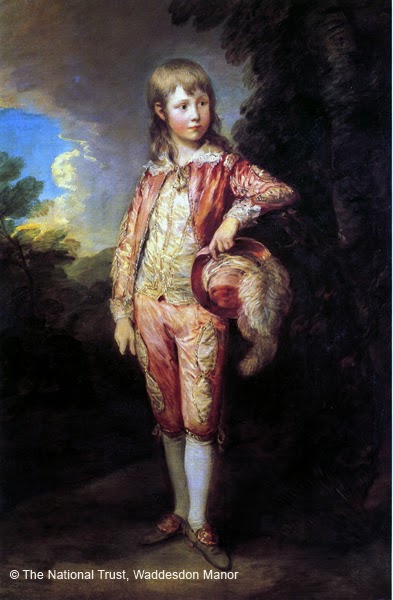
Jane Austen thought boys should wear pink


She was not making any challenge to gender stereotypes and she was not at all alone in her opinion. In the old days, pink was considered a boys' colour and blue was for girls. Pink is a shade of red, which was thought to be masculine and strong; whereas blue was considered delicate and soft and feminine. My sole authority for this is an episode of QI, so if I am wrong, I blame that program entirely.

Apparently, this was the case until the 20th century. Stephen Fry shared a story about a princess in Belgium, I think, in the 1930s who had painted her nursery blue in anticipation of having a baby girl. It was quite scandalous when she had a boy, and the press laughed at the idea of putting a baby boy in a blue room. She would definitely have to re-paint lest she offend her son's masculinity.

I suspect this was more the case in Europe. I asked my grandmother, who was around in the 1930s, and she had never heard of this reversal. I have been told by a friend that the French used pink for girls and blue for boys, and the Germans the reverse. French came to dominate in the area of fashion, so we now all think of blue as a boy colour and pink as a girl colour, or at least that they used to be so. Pink is, of course, for everyone, as is blue.


I am sure I have read many places that English children wore white. They certainly did as babies. They wore long white dresses. It was much easier to dress and to change them that way, and was much warmer. At what point they started wearing colours I am not sure.

In the same episode of QI, we were also told that all children used to be called girls. Boys were called knave girls and girls were called gay girls. I looked this up. At least according to Wikipedia, it is true. The word girl came to be used exclusively for females around the end of the 1500s.

While on the subject, the word man used to be used for all people. Wer, or werman meant man and wif or wifman meant woman. Eventually, the wer was dropped for men and wifman developed into woman. After the great vowel shift (see earlier post) wif became wife, and came to refer to a married woman, though it is still used to mean woman in the word midwife. Wer is mostly gone, with the exception of werwolf.

So, when someone refers to the race of men, or mankind, they are not being sexist; they are just being old-fashioned, and, in a sense, more accurate.

Melanie Kerr is the author of Follies Past: a Prequel to Pride and Prejudice

Read Chapter 1      Watch the Trailers      Download eBook      Order Paperback

Wednesday, 2 October 2013

Lead face powder - because you're worth it!

We kill ourselves for beauty, or so I have heard it said. And it is as true now as it has ever been, but the means were not always so subtle. In the 18th Century, as indeed in most of history, pale, milky skin was valued by the English as an indication of prestige. If you were tanned, it meant you spent a lot of time in the sun, probably working, and the upper classes wanted to get away from this image as much as possible. This ultimately resulted in ladies, and in fact some gentlemen, painting themselves white.
We may dust our faces with bronzing powder, but they painted their skin with led paint. You can only imagine the wonders this did for their complexions. Yes, it ate holes in their faces and made their eyebrows fall out. And that is not to mention the countless other illnesses and even death that were caused by the direct application of lead to their faces.
To remedy the loss of eyebrows and pocks on the skin, they adopted some other gruesome tactics. They made false eyebrows out of rat hair which they would actually glue to their faces and they covered their pocks with moleskin patches. These latter became a fashion of their own, and varied a great deal in size and shape. When you see an obviously false beauty mark being sported by an 18th century lady with a pale complexion in an old painting, that is a moleskin patch and is covering up a hole in her face.
Fortunately, by Jane Austen's time, this look was starting to go out of vogue. By the time she was writing her novels, it was certainly not fashionable among the young. I have heard several theories as to why that was, but I will save that for another post. 
Ladies did still continue to use rouge, but they would always deny it. I think there are some scenes in Moll Flanders (the book, not the film, which I love, but which takes only its title and none of its plot from the book) in which some ladies are accusing each other of using rouge, which accusations are hotly denied. And, according to Sir Walter Elliot, if Lady Russell would only wear a little rouge, she would not be afraid of being seen.

(Follies Past: A Prequel to Pride and Prejudice, is a novel by Melanie Kerr. Expected publication date is October 31, 2013. Until then, I will be posting things I learned in the course of my research and of my life so far as a geek. Sharing always welcome and encouraged. Follow me on twitter @FolliesPast and on facebook.) 

Tuesday, 1 October 2013

Tired of Pemberly's extensive but predictable grounds? Spice things up with a hired hermit!

The idea of a house having a view is quite a modern one, well, if you think the 18th Century is modern. It was always the house that was the view. I am, of course, talking about grand estates, not houses for normal people. It was more important to the well-to-do that they maintain their image than that they enjoy their life. And so, their houses were show-pieces from the outside as well as the inside, possibly more so since not everyone would get to see the inside. Therefore, it mattered more that the house ornamented its surroundings than that the people inside had anything to look out at through the glass.
One famous landscape architect you may have heard of was called Capability Brown. His name wasn't actually Capability, but that's what everyone called him because he could do anything. He really changed English gardens forever. He re-ordered hills and lakes and all sorts to make it look like the house was perfectly situated without any human interference. He created rolling hills, vast lawns and asymmetric shrubberies, and did away entirely with the ornamental gardens that had previously prevailed. They continued to be the done thing in France, a la Versaille et al. But in England, things were going another way entirely.
One individual who was an unwitting and accidental but undeniable influence on landscape architecture was actually a sketching artist. In the 18th Century, for reasons I don't understand, travel became easier, and there started to develop a tourist industry of sorts among the upper classes. Why this happened, I don't know. They didn't have steam boats. They didn't have railways. They didn't have paved roads. They didn't even have suspension in their carriages. So what made it easier to travel? Was it political conditions? I don't know, but apparently it was. Consequently, society ladies started going on holidays, and they liked to do drawing. One Mr. Gilpin wrote a few books about drawing, particularly drawing exotic landscapes, and suggesting good spots to draw in popular tourist areas like Italy and the Highlands of Scotland. He invented the word, and the concept, "picturesque." This has now come to mean that something is merely pretty, but it had a more specific meaning when he used it. He meant it to describe subjects that would make good pictures, for specific compositional reasons. There had to be something framing the foreground, some interesting subject matter in the middle ground, and some dynamic background. Items must be grouped in odd numbers, like cows in a field or people in a crowd, and, most importantly, the main subject matter should have lots of craggy lines, like a ruined castle or a rock face. Straight lines, new buildings, these were not picturesque.
This last principle started to be taken up in landscape design, and people started doing things like building follies, which were false ruins, on their properties. They wanted interesting things to look at out of their windows, to see pictures where they looked instead of just being the picture. I don't know that Mr. Gilpin is solely responsible for this, but he was part of a growing fascination with rugged and ragged things, like the French Pyrenees and secret coves. Therefore, some of the follies they built were hermitages, little hidden hovels that suggested a bit of excitement. And there were some who even went so far as to hire a hermit. possibly a poet, to live in their folly hermitage. Therefore, it became a sort of adventure for the rich to go for walks and chance an encounter with a real hermit. 
What lengths the bored and wealthy will not go to for a little diversion.

(Follies Past: A Prequel to Pride and Prejudice, is a novel by Melanie Kerr. Expected publication date is October 31, 2013. Until then, I will be posting things I learned in the course of my research and of my life so far as a geek. Sharing always welcome and encouraged. Follow me on twitter @FolliesPast and on facebook..) 

Wednesday, 25 September 2013

If Jane Austen wanted to be patriotic, she could wear a dead person's teeth

You will recall from the last line of my last post that teeth were a serious problem in the old days, so serious in fact that it killed people by the score. I have heard that in medieval times, you could sue for divorce on the basis of bad breath from rotting teeth. If you have ever seen a specimen of medieval teeth, it is pretty shocking.
In the Georgian era, some people used birch twigs, chalk and salt to clean their teeth, but I am not sure how universal a practice this was. Certainly, people still had very bad teeth. If you recall from my post about tea, you might remember that the Georgians ate a lot of sugar, or at least they did if they could afford it. Not only did they put excessive amounts of sugar in their tea, they also ate cake constantly. They ate cake for breakfast; I kid you not. They ate little cakes with their tea. They didn't have lunch, so they just snacked on cake. This rotted their teeth, obviously. At least, if you could afford sugar it did.
Resulting infection was, I believe, what caused death by teeth. There were no anti-biotics, and dental care was pretty horrific. In fact, I imagine going to the dentist might actually be more dangerous than not, given that people didn't know about germs and definitely did not sanitize anything, even if they did clean it, which is questionable.
The only real treatment was to pull the tooth. If you were rich, you could be drugged with laudanum first; Chloroform came later. Once the tooth was out, then what? Did you just go around with a tooth missing? You could, I suppose, but preferable were false teeth. They didn't make artificial teeth out of plaster like they do now. They used dead people's teeth. 
The market for teeth was quite a hot one. You could even wear dentures made of a whole set of a dead person's teeth. They wouldn't fit very well, but it's better than dying of toothache, and better than toothlessness. 
The most popular teeth were those of fallen soldiers from the war in France. It was considered patriotic to wear a soldier's teeth. People would  scour battlefields scavenging for jewelry and buttons and money, but they also went about taking out the soldiers' teeth which they would sell back to the English. I don't see at all how it would be patriotic to participate in this atrocity by purchasing such teeth, and I don't know how anyone could verify the source of the teeth, but I suppose they just wanted to keep the memory of the soldiers alive and near to them... in their mouths.

(Follies Past: A Prequel to Pride and Prejudice, is a novel by Melanie Kerr. Expected publication date is October 31, 2013. Until then, I will be posting things I learned in the course of my research and of my life so far as a geek. Follow me on twitter @FolliesPast.) 

Monday, 23 September 2013

Mr. Darcy didn't wear underwear, but he might have stuffed his socks

Georgians loved all things neoclassical. You can see it in their architecture, their art, even their clothing. Although we usually think of men of this period dressed in black, by 1813, when Pride and Prejudice was published, it was not really en vogue, except maybe for clergymen. I am pretty sure they always wore black. But for fashionable gentleman, it was much more stylish to try to look as much as possible like a Grecian marble statue. This meant wearing light, creamy tones and very tight britches, often made of calf-skin.
As you have no doubt seen in costume dramas, they did not usually wear long trousers, but rather short ones with long socks. One advantage of this was that it allowed a gentleman to display his shapely, Grecian calves. If one's lower legs were wanting in bulk or definition, all was not lost. One could pad them up. It was actually possible to buy calf-shapers to put into your socks. As Mr. Darcy abhors deception of any kind, he may not have participated in this trend, but it was certainly possible. I do find it difficult to believe that a lady could not tell that a man's legs were not her own, but perhaps it is like a push-up bra. It doesn't matter that it is obviously the work of a bolstering garment. The effect is as desired.
As for underwear, neither men nor women wore any in the Georgian era. Underwear as we know it didn't exist at the time. Bloomers were just beginning to make an appearance on the scene, but were a bit useless. They were not in one piece but came in two separate legs, each with a tie to go around the waist. They did not really cover you up very effectively, and were prone to coming undone and falling off. I really do not know how they came to be popularized at all. Eventually, someone came up with the brilliant, though apparently not obvious, idea to sew the two legs together, as had been done with trousers for centuries.
Previous to bloomers, Ladies simply wore petticoats. Actually, in the Regency, they wore a chemise, which is like a loose, light, shift, then a stay, which is like a cross between a bra and a corset, then a petticoat or two, and then their dress, or gown as they would have called it. All together, the length and weight of their dress obviated the need for any underwear. They were pretty well protected. On their legs, they wore high socks. I cannot confirm that they did not use any sort of garter to keep them up, but I am pretty sure they just tied ribbons around the tops and hoped for the best.
The men also did not wear any underwear. Many modern people do not realize that a man's shirt functioned as his underwear. Shirts were extra long, and men just stuffed them down and around to cover themselves up. So, the romantic image that we have of a man in a flouncy shirt with an open collar, writing poetry by candle light is perhaps not so alluring when you consider that the bottom half of that shirt is not very sanitary. This is why a gentleman was never seen in his shirtsleeves in company, because a gentleman doesn't wear his underwear in front of other people. And this is why I am so outraged by the scene in the Pride and Prejudice film where Matthew McFayden (dreamy as he may be) is out for a stroll at dawn in his open shirt. MR. DARCY WOULD NEVER ROAM THE DOWNS IN HIS UNDERWEAR!
Sorry for yelling. I am excessively attentive to Mr. Darcy's reputation.

(Follies Past: a Prequel to Pride and Prejudice, the novel, comes out October 31, 2013. Until then, I am posting things I learned in the course of my research, and of being a geek. Sharing always welcome. Follow me on twitter @FolliesPast)

Friday, 20 September 2013

The "beheaded" look was an actual fashion trend in the time of Jane Austen

Marie Antoinette, like many queens before her, was very influential in the world of fashion. She is even credited with creating the empire waist gown that we associate with the late Georgian and Regency periods. She had a little cottage constructed for herself, with a humble country garden surrounding it and she spend her days there, pretending to be a peasant. She would wear a simple shift or petticoat with a ribbon around it, and I have heard it suggested that it was in imitation of this style of dress that the Napoleonic fashion was born. Certainly, the gowns of Jane Austen's time resembled more the dress of peasants than the absurdly ornate courtiers' gowns of the late 18th Century.
When Marie Antoinette was ultimately beheaded with her husband, so powerful was her influence that fashionable ladies began to recreate the image of her, post-guillotine. They cut off all their hair, in a ragged way, as though it had been done by a prison barber, as Queen Marie's would have been. They then wore a red ribbon around their necks to indicate the would-be cut of the blade that was to have severed their head from their body. I am not sure just how common this fashion was. A lady would certainly have to be committed to it, since she had to cut off all her hair in order to sport it. But if you want to see an example, or evidence that I am not making this up, you can watch Wives and Daughters, the mini-series. (Actually, you should watch it anyway. It is lovely.) About half-way through, one of the characters, a very wealthy and fashionable lady, shows up to a ball dressed just as I have described. Gruesome, I know, but true.
And you thought Heroin Chic was too much!

(Follies Past: a Prequel to Pride and Prejudice, the novel, comes out October 31, 2013. Until then, I am posting things I learned in the course of my research, and of being a geek. Sharing always welcome. Follow me on twitter @FolliesPast)

Thursday, 19 September 2013

Once upon a time, you could rent a pineapple

This sounds so ridiculous, I thought it was very fitting in relation to a book called "Follies Past." It is true. I learned about it at a Jane Austen Society of North America Edmonton Chapter meeting.
Pineapples used to be a sign of prestige. They were very expensive, and displaying one in your fruit bowl told the world that you were of a certain class or standing. If you couldn't actually afford to buy a pineapple, there were  fruit vendors who would rent it out to you for a smaller fee, but you had to return it unharmed. Pineapples are quite hardy, but they do not last forever, and there are stories of people having rented a pineapple to impress their guests, and their guests - being duly impressed - asking to taste it. In these stories, the poor renters of the pineapple were doubly injured. They had to comply and cut open the pineapple, costing themselves a hefty fee with the grocer, and the pineapple was rotten through, costing their reputation with the guests they were trying to impress.
The very best country houses had pineries, specialized greenhouses for growing pineapples. There was a lot of competition for the best gardeners to get yourself the best crop. Yes, you can grow pineapples in England.  I am told also that you can grow pineapples as household plants. You just plant the green top of the pineapple in enough soil and it will grow into a plant. I have not tried this, but if anyone has, please report the results below.
Pineapples have also long been a symbol of hospitality. That is why you often see carvings of them adorning gates and bedposts, and why they are such a popular design on tea towels and serving dishes. I don't know why exactly they became such a symbol. If you know, please share in the comments. I suspect it is related to the prestige that they represented, i.e., you are welcome to everything. We have enough to share. We even have pineapples...

(Follies Past: a Prequel to Pride and Prejudice, the novel, comes out October 31, 2013. Until then, I am posting things I learned in the course of my research, and of being a geek. Sharing always welcome. Follow me on twitter @FolliesPast)