Monday, 20 April 2015

5 of the best Costume Dramas you have probably never seen

I concede that I may underestimate the comprehensiveness of the viewing public's experience with costume dramas, and that you may, in fact, have seen all of these, particularly if you are someone who reads this blog, which is clearly directed at people like me, who are costume drama junkies. This is a list of costume dramas that I count among my favourites, but that I rarely, if ever, hear anyone mention. I confess, I kind of like that nobody ever talks about them, because it allows me the somewhat narcissistic pleasure of being the one to tell others about them. These are listed in no particular order, except that I saved the best for last.  And I limited myself to films, just to be kind of consistent.

Songcatcher
If I could describe this movie in a word it would be 'subtle.' It doesn't beat you over the head with anything, and it kind of fades into the background of your memory, which is probably what accounts for its obscurity. But that does not mean you should not watch it. It means that you can watch it again and again without getting sick of it. The story is of a musicology professor who visits her sister in the mountains and becomes determined to capture the traditional music she there discovers. It is just sort of lovely, and with such great music. Snuggle up on the couch with a cup of tea and a ready sigh, and enjoy.


The Damned United
This probably pushes the definition of costume drama since it is set in the 1970s, but still, it is a different time, and the aesthetic takes some crafting. Therefore, I am including it. I am also including it because it is such a great movie, and I have  never heard anyone mention it. I am pretty sure it was not a huge box office hit, even across the Atlantic where people know who Brian Clough was. He was a football (soccer) manager, and is the lead character. Normally I would not have five minutes for a sports film, but this was really a character piece, subtle and stylish and not at all requiring any interest in the game itself.


The Conspirator
I think about twelve people saw this movie. I certainly do not see it included in any lists of best costume dramas anywhere, yet it is, in my opinion, one of the most clever and thought-provoking films of our time. Do not be put off by the Americana look of the branding. The plot is based on the trial of one woman accused of conspiring to assassinate President Lincoln, but the theme is really an exposition in defence of the rule of law that I expect escaped the average viewer. I, however, left the theatre reeling with the implications of all the film had to say. It is a movie that will make you think, in a good way, while engaging you in a riveting drama that stands on its own as a fascinating bit of storytelling.

Max
Of all the films I am listing here, I feel most confident in assuming you have not seen this one. It was a made-for-TV movie that I only watched because I was determined to watch everything John Cusack had ever been in, and he plays essentially the lead role. It is the story of Adolph Hitler in the early interwar period, when he was an aspiring watercolour artist and WWI veteran. Cusack plays a Jewish art dealer who takes an interest in his work. The portrayal of this character of Hitler can only be called brave and fascinating. Who is there in history more infamous, more reviled? How can you possibly show him as anything but a horrific, demented monster, while still trying to offer some kind of understanding of where he came from? The character in the film is despicable and pathetic, and still believable. It feels like you could actually know that person, which is terribly frightening. It is not a luscious kind of costume drama. It is not about the aesthetic of the period. Most of it takes place in a warehouse. It is character driven and incredibly well done. Plus it has Molly Parker in it (go Canada!).

Down with Love
From what I can gather, this film was a box office flop, and being set in the 20th Century, might not be what you think of as a costume drama, especially since it is a comedy. Some might think it not deserving of inclusion with the other films listed here, but I stand by my choice. I don't subscribe to the view that a movie has to be weighty to be good. There is no angst involved in this one. It is clever, adorably mid-century and highly enjoyable. Yes, it is not a serious film, but it gets 5 stars from me because it does precisely what it sets out to do, and does so with style. If you are looking for something light-hearted yet well-crafted, this one comes with my enthusiastic approval. I have probably watched this ten times and am still not tired of it.


Cradle Will Rock
This is my favourite film of all time. I have yet to be so blown away by a film as I was by this one, and were it not for a mention of it in a newspaper listing in the late 1990s, I might not have heard of it. That's a lie. It has John Cusack in it, so I would undoubtedly have heard of it. The incredible fact of this film is who else is in it: Bill Murray, Vanessa Redgrave, Susan Sarandon, Emily Watson, Joan Cusack, Hank Azaria, Cary Elwes, Paul Giamatti, John Turturro, Tenacious D (both of them), and the list goes on. How could you not have heard of this movie, you might ask yourself? I ask the same question.  It is written and directed by Tim Robbins, who, though famous, is not as renowned as he deserves for all his diverse genius. I cite Bob Roberts as my evidence. (It's not a costume drama, so couldn't list it here, but watch it anyway. It is my second favourite film after Cradle Will Rock. It's like Wag the Dog meets Best in Show meets something infinitely superior to either.) When I watched Cradle Will Rock for the first time with a group of friends, we actually all stood up and cheered aloud at the screen. BRAVO! BRAVO! Oh, I am getting excited just thinking about it.

In addition to the films listed above, there were a few that I thought too well known, or critically recognised, to be included, but still somewhat obscure, and deserving of a little more praise, even if you have seen most of them. I have set them out below. If there are others you think worthy, please mention them in the comments as well.

Mrs. Henderson Presents
Judy Dench plays an eccentric, aristocratic widow who decides to take charge of a theatre left to her by her late husband. It is set in WWII during the blitz, and is poignant, amusing and everything you want it to be.


Amazing Grace
I don't really know what to tell you about this film except that if you are looking at it thinking, "I wonder if this is any good?" it is, and you should watch it. It has lots of great actors in it, including the ubiquitous Romola Garai and many, many others. It is about Lord Wilberforce and his quest to abolish slavery. It is the first film in which I saw Benedict Cumberbatch, playing Pitt the Younger long before he was any kind of heart throb. It captures both the personal story of WilliamWilberforce as well as the great historical drama of human rights and the law.


Moll Flanders
You might be aware that there is a novel of this name, by Daniel DeFoe. Do not be fooled. They both bear the name of their title character, a woman in 18th Century England. However, there end the similarities. There is virtually nothing in this movie that could be said to have been taken from the book, but it need not necessarily follow that the movie falls short. In my own, possibly singular opinion, the film is actually far superior to the book, perhaps not in their entire respective historical contexts, but just as something to pick up here and now. I expect the discrepancies account for the mixed reviews. If you haven't read the book, or are able to set aside any expectations of this as an adaptation, I recommend this as a film that will make you want to cheer out loud.


Hilary and Jackie
This film was nominated for 2 Oscars, but it still is not that well-known considering how brilliant it is. This might have been the first role in which I saw Emily Watson, and I have certainly been devoted to her ever since. The film is the true story of the famous cellist, Jacqueline Du Pre, and her lesser known sister, flautist Hilary. It tells the story twice, once from the perspective of each sister, and it has such great acting and writing. It is moving and at times a bit disturbing, but utterly compelling.


Miss. Potter
This one did win a Golden Globe and it does star more Hollywood-level celebrities, specifically Ewan MacGregor and Renee Zellwiger, a pairing I think is destined to be classic. Oh, and again it features Emily Watson. I must really like her or something! It is the story of Beatrix Potter, with all her brilliance and idiosyncrasy.  It is so pretty, and touching, and lovely. I could watch it over and over


The Young Victoria
Oh what a pretty, pretty film this is. If only Queen Victoria had looked anything like Emily Blunt, poor girl. You have all probably seen this, but I just wanted to list it because I love it so much.


Ever After
I have confessed many times in this blog to being a huge Disney fan, and lover of fairy tales. I hope the readers are not so prejudiced as to consequently doubt my intelligence or discernment in the art of film or historical portrayal in general. This film is supposed to be the story of what "really" happened to the "real" Cinderella. To me it is a terrific balance of Hollywood fantasy, humour and great storytelling.


Bright Star
The worst thing about this film is the Scottish accent of one character. Otherwise, I cannot find any fault with it. It does get mentioned in lists occasionally, but I don't think it is a really high-profile movie. It is a very personal and understated portrayal of Keats near the end of his all-too-short life. It captures his genius and the tragedy of his death without milking it. It makes the people all seem very real and, to a point, ordinary, though obviously poetic and intellectual. It is beautifully shot, but still a bit gritty, though not in that obnoxious let's show everyone how horrible the olden days was kind of way. It's just very intimate. Plus, it stars Freddie from The Hour and I love him.


These are all based on my personal taste, which not everyone may share, but I hope I may have brought to your attention a new favourite that you might not otherwise have heard of or considered watching.

Please also do watch the video at top right about the upcoming Regency costume ball taking place in Calgary May 16, 2015.

Melanie Kerr is the author of Follies Past: a Prequel to Pride and Prejudice

Read Chapter 1      Watch the Trailers      Buy the Book

Thursday, 9 April 2015

What would Jane Austen eat for breakfast?

The answer, tea and toast, is not very interesting I grant you, but the rise of the tea and toast breakfast, at least in my opinion, is.

You see, not long before her time, the usual breakfast of English champions was the famous Beef and Ale breakfast. Yes, that's right, beef and ale for breakfast. Appetising right?

In my post about death by teeth, we learned about how the English loved their sweets, but they also were renowned for their love of meat. The French called them a country of flesh eaters. They mostly lived off meat and cake.

As for the ale, well, it was weaker than the beer we drink now, quite watery in fact. Until they started drinking tea, the English pretty much didn't drink anything that wasn't at least a little bit alcoholic. This is because alcohol cleans the water, so adding a little makes things safe to drink. Water was not considered safe to drink on its own, and it probably really wasn't. I have heard a theory, which makes a good deal of sense to me, that the real reason Bath was so effectual at curing certain illnesses is because people "took the waters" there, from the spring. It was reputed that it contained healing properties. Perhaps it did. But it was also the only water they drank. And they were often prescribed it in rather large dosages. For a people who lived on meat, sugar and alcohol, this alone was probably sufficient to address many of their ailments.

You will recall Mr. Woodhouse, in Emma, drinking wine and water, which was considered a very mild drink. Ale was particularly popular because you could grow grain in England, and therefore it was in ample supply. But tea was another story.

We think of tea as quintessentially and eternally English, but if you think about it, that can't possibly be true. As you might guess, tea doesn't grow in England. There is a woman in Victoria, Canada, who is starting to grow tea, but it is very weak and will take generations to develop into something drinkable, and may never be any good because,although Victoria is the warmest part of Canada, it is still really too cold for tea.

In England, I am not aware of anyone even attempting it. But those cheeky colonials got away with claiming for England lots of other countries, and with them all their resources. As the British Empire expanded into the East, the English were introduced to tea. In later years, they would go to great lengths, including devastating wars, to keep their tea supply flowing.


The excellent benefit of tea was that it required the water to be boiled, making it safely drinkable. It was VERY expensive and consequently became very fashionable. By Jane Austen's time, it was indispensable. See my post about tea, to read about just how valuable it was.


There were, however, those who did not think tea was right for England, crotchety old men who thought beef and ale was perfectly good for their ancestors and should be perfectly good for everyone else - none of this foreign, new-fangled tea business coming in and taking over the good, old-fashioned English ale. Some said tea was bad for the health, citing the change in the complexion of young ladies as evidence. Tea has taken the blush right out of their cheeks, they said. Never mind that it was not the tea taking it out so much as that the young ladies were no longer in a constant flush from being ever so slightly drunk.

Having abandoned their beef at breakfast time, the English clung to their cake. With their tea and toast they also ate pound cake, and lemon drizzle and various other sweet baked goods. They also drank cocoa. This was probably the healthiest thing they ate. Cocoa at least has some antioxidants. And they didn't at first take it sweet like we do. Cocoa was initially a watery, spicy drink, not at all the sweet, creamy thing we have with marshmallows around the fire. They may also have eaten chocolate, but I cannot confirm that. And I very much doubt Mr. Woodhouse would approve if they did.

Melanie Kerr is the author of Follies Past: a Prequel to Pride and Prejudice

Read Chapter 1      Watch the Trailers      Buy the Book

Wednesday, 8 April 2015

Studies have shown, Queen Victoria lived for almost a thousand years

The manor house which my brother, to his eternal
shame, unwittingly referred to as a cottage
By studies, I mean the vernacular of colonials. I have long noticed, to my great amusement, that for North Americans at least, the word "Victorian" refers to anything predating the First World War. I have heard many such charming remarks as, "I love Downton Abbey, especially the Victorian costumes" or "When you go to the Jane Austen festival, do you wear Victorian dresses?"

I do not wish to be like that English woman who bit my brother's head off for calling the stone manor house a cottage, but I thought I might just clarify a few things in case you don't know. I assume most of you do know, in which case, I write this so that you have something to which you can direct people when you haven't the time or the inclination to tell them why they don't love all that Victorian stuff in "The Tudors."

Also, I have been organizing a lot of Regency events lately, like the Springtime Ball advertised on the right (you should totally come), and an explanation of what is meant by 'Regency' may be useful.

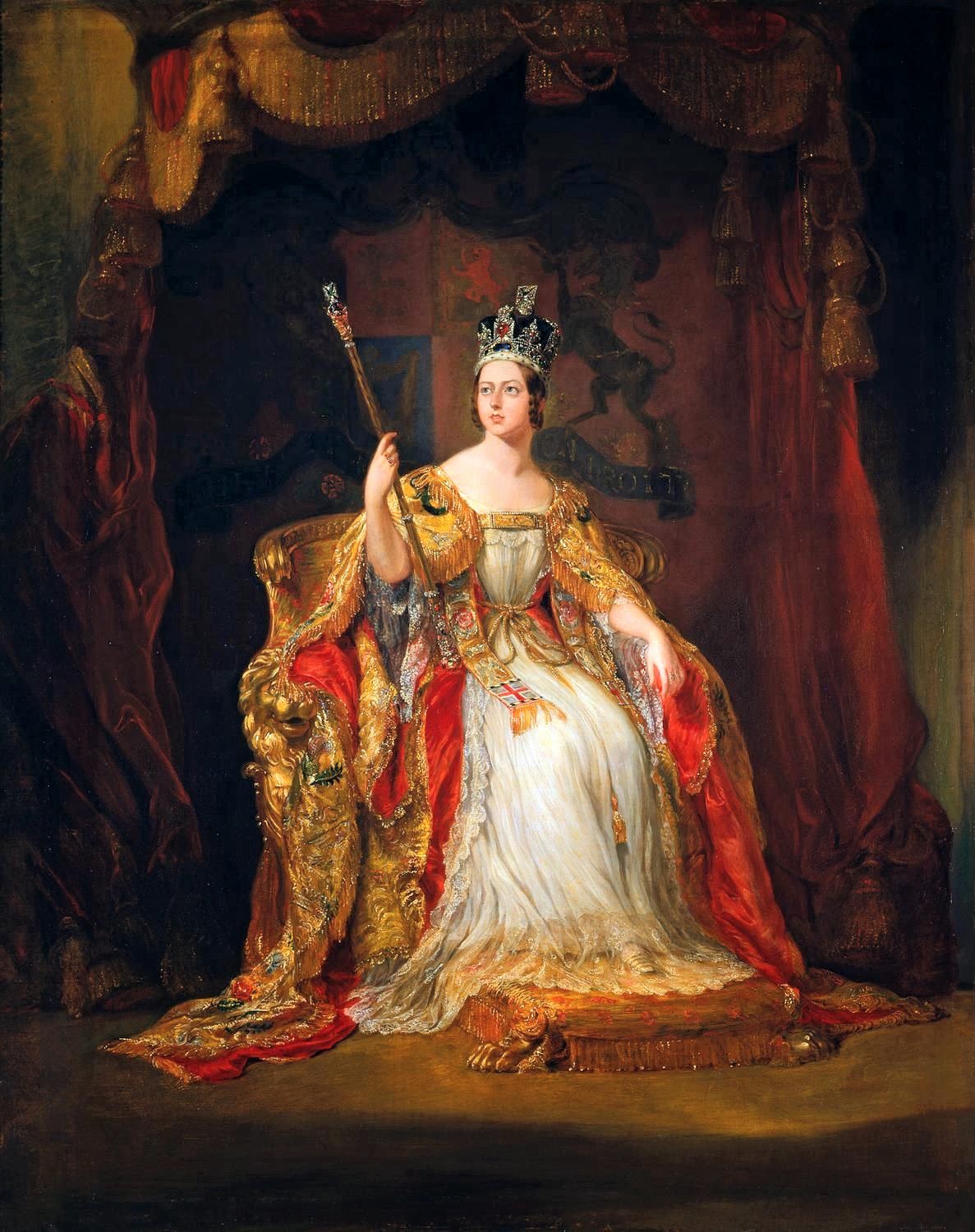
Young Queen Victoria at her coronation in 1837
Eras in English history are mostly named after the monarch reigning at the time. The Victorian era refers to the time when Queen Victoria ruled England. She became queen in 1837, aged 19, marking the beginning of Victorian England.

She died in 1901, at the age of 83. The intervening 64 years only are what we can call the Victorian age, or era. Nothing before, and nothing after.

Hers was the longest reign in English history and, I grant you, a long time for any single monarch, so it is somewhat understandable for people to think it covers pretty much all of the olden days. Furthermore, the Victorian era was remarkably prolific, particularly in terms of literature and technology, so much so that we who are so far removed from any other knowledge of England's history think that everything ever produced in the olden days, must be Victorian.
Queen Victoria near the end of her reign

Downton Abbey opens with the sinking of the Titanic in 1912, which is, at best, the Edwardian era, though King Edward himself was actually dead already, as of 1910. His son was on the throne, so that is really two monarchs removed from being Victorian.

Jane Austen's works were published in the second decade of the 19th Century. Jane Austen herself died in 1817, 20 years before Queen Victoria took the throne, and in fact, a year before she was even born. The era we associate with Austen, and when all her books were published, is called the Regency, though you may have heard me refer to it as the Georgian era. Allow me to explain.

There were several kings in a row who were all called George, and their collective reign is therefore known as the Georgian era, or period. The first of the Georges became king in 1714. The third one, George III, was on the throne when he started to become mentally ill in the late 1700s and early 1800s. They made an excellent film about it called "The Madness of King George." It was going to be called "The madness of King George III" but the producers thought American audiences would not go see it because they had not seen the first two movies in the trilogy. God bless America.

King George III had a son who was also called George, specifically Prince George. In 1811, George III was declared unfit to rule and his son took over, but not as king - as Prince Regent. A regent is someone who rules in a monarch's stead while that monarch is unable for some reason. This sometimes happens when a child becomes king or queen. The monarch is a figurehead only, and a regent is appointed to do the actual job of being in charge.

A young prince George, most likely before his Regency,
though I could not find a date. Please comment if you know
when this portrait was done.
Prince George ruled as Regent from the age of 39, in 1811, until his father died in 1820, at which point the Prince Regent became the King. Those nine years were and still are aptly called the Regency. It is, however, still correct to call it Georgian, or late Georgian, as the prince was after all a George, and became King George IV, extending the Georgian era until his death in 1830. Some include the subsequent reign of his somewhat under-appreciated younger brother, William, as part of the Georgian era, and that takes us right up to 1837 and the reign of his niece, Victoria.

If you watch the film "Young Victoria" you might discover that she was pressured to allow someone to rule as her regent when she inherited the throne, but she refused. You may also be falsely led to believe she looked something like Emily Blunt, whom I adore, but who really is so lovely, one could be deceived into thinking Queen Victoria was a beauty. I assure you, such was not the case.

So, now you know that the stuff you love in "The Tudors" is Tudor, and everything in "Elizabeth" is Elizabethan. And if you don't know, or don't particularly care about the exact historical period, you can always just call it old.

Melanie Kerr is the author of Follies Past: a Prequel to Pride and Prejudice

Read Chapter 1      Watch the Trailers      Buy the Book

Monday, 6 April 2015

To endeavour to attempt to use the word "try"

Whenever I read things written in the present time, but intending to feel like they were written 200 years ago, I always come across words that take me out of my suspended disbelief. I have written several blog posts under the tag "write like Austen" on these words and the differences between their modern usage and their former meaning. I have no idea if they are useful to anyone, or even interesting, or if anyone even reads them, but I hope so.

"She has got over the most trying age."
A word which can give you away as a modern writer when writing in Regency English is "to try." In the sense of trying to do something, it was not as frequently used 200 years ago. It was used, but more often with a different meaning, one that it can still bear but is not so common, which is to test something.

This can be in the sense of seeing if something works, or of making something difficult. Think of Lizzie saying to Wickham that Georgiana "has got over the most trying age." Or Mrs. Bennet saying that something tries her nerves, or tries her patience.

You might say "try the door," which would mean, test the door, or see if the door will open. Saying, "I have tried to open the door," is not as elegant, in my opinion, and not as common a historical usage.

"It ought not to be attempted."
I recommend, as is probably a good general rule for writing, seeing if you could use a different word or expression. Some examples might be to attempt, to endeavour, to strive, to make an effort, to struggle. Not only might they be more descriptive and evocative, but they are more appropriate to the period. Recall that when Jane asks Lizzie whether they should let their acquaintance know about Wickham's true character, she replies "that it ought not to be attempted."

My feeling is that it will make your writing more authentic if you are aware of these different meanings of "to try" and if you mostly use it in the sense of testing the capacity of something, or being difficult, and if you mostly use other words when referring to one's exertion.

Melanie Kerr is the author of Follies Past: a Prequel to Pride and Prejudice

Read Chapter 1      Watch the Trailers      Buy the Book

Tuesday, 24 February 2015

Cinderella and the Glass Slipper

On March 13, Disney releases its new re-telling of this classic tale.  As an unabashed Disney fan, I look forward to it with great anticipation. Also, I love alternative re-tellings (Wicked, Maleficent, etc.) I hope to go on opening night with a large group, either in costume or in pyjamas.

I thought this would be a good time to air my beef with Stephen Fry. Well, I suppose he just reads the cards the QI elves give him, but whenever he says something wrong, I feel I have to dispute it at least to my readers. Please note that I actually adore Stephen Fry and his show. I'm just a bit uppity and excitable when it comes to historical trivia.

In one episode of QI, Mr. Fry states that Cinderella never wore a glass slipper, that this was a translation error and that the slipper was made of squirrel fur. This, he suggests, is because of the homophony of the words "vair" and "verre" in French, the language in which the most popular version of the story was first written. Note that this is the version on which is based the Disney cartoon film, which is (surprisingly for Disney) really rather faithful to the tale on which it is based.

I did a bit of research on this question, and I am convinced that Mr. Perrault, who first included the glass slipper in his telling "Cendrillon" in 1697, intended that it be a glass slipper, not a fur one. Here are my reasons, for your consideration:

1. The word in the story is written "verre." It appears numerous times in the story, and is always spelled this way, which means "glass." It never appears as "vair" or "fur."

2. There is no evidence Perrault did not know how to spell. He does not have a history of confusing the spelling of words with their homophones. By all accounts he was a very learned and erudite guy. Although spelling in the 17th Century was more flexible than it is now, there is no evidence that I am aware of that "verre" was ever an acceptable orthographic variation of "verre." Furthermore, where multiple spellings are acceptable, one usually finds that the word is spelled in different ways within a particular manuscript. Jane Austen, for example, uses both "friend" and "freind" in her books. Only "verre" is used by Perrault in Cendrillon.

3. I have not been able to find any contemporary illustrations for the Perrault story, but at least this one, done in 1862 by Gustave Dore (there should be an accent aigue above the "e" but I can't do one in this program), shows what looks to me like a glass slipper, suggesting that  at least19th Century folk, in France where Perrault first wrote and published his version of the story, believed it was made of glass.

4. One of the reasons for believing that there was a confusion between "vair" and "verre" in this story is that it seems ridiculous to have a slipper made of glass, whereas a slipper made of fur makes perfect sense. Need I remind these people that this is a fairy tale? Everything about it is ridiculous. They make a carriage out of a pumpkin. Perrault was renowned for his creativity. He was practically (though not actually) the founder of the fairy tale as we know it. There is no reason to exclude the possibility of a certain element of a fairy tale because it is fantastical. See my reasons below as to why glass actually makes more sense than fur.

5. The qualities of glass fit the story. Glass, in the 17th Century, was very precious. In the Grimm version of the story, the slipper is made of gold, reinforcing the notion that it was made of a precious material. Furthermore, the very fragile nature of glass fits the ephemeral idea of magical garb that lasts only one night. Also, any lady wearing a slipper of glass must be very graceful and dainty, or they will break the slipper. This implies that Cinderella was all these things, which is consistent with the nature of her character. Unlike fur, glass has absolutely no give. It does not stretch. It would have to mould to the foot in order to fit. Given that only Cinderella can fit the slipper, it makes sense that an inflexible material, like glass, suits the plot of the story better than fur, which might stretch and bend to fit another lady's foot.

I don't know whether I have convinced you or not, or whether the elves at QI might ever reconsider their position, but this is how I came to my own conclusion about the glass slipper. I hope the new Disney film delivers, and is at least as entertaining as this blog post!

Some of my favourite people, on the set of QI, in fitting costumes for the subject of Cinderella


Melanie Kerr is the author of Follies Past: a Prequel to Pride and Prejudice


Sunday, 15 February 2015

The Regency comes to Calgary, May 16, 2015

On September 28 last year, Edmonton saw its first Regency costume ball, which took place in the sumptuous Wedgwood Room of the Hotel MacDonald, which is actually a certified castle. To own the truth, I think of it as my castle. It isn't. I just feel an affinity towards it. For pictures and details, see my post about that event, which was so popular, we had to do it all over again to accommodate those who couldn't get tickets. 

Dancing in the sumptuous Wedgwood Room at the Michaelmas Ball

We are currently in the midst of dance lessons for the Regency Midwinter Ball taking place again at the Hotel Mac, on February 28.

Dance lessons begin for the Midwinter Ball

If you missed that as well, or if you simply cannot get enough Regency loveliness, then have I got news for you! I am bringing the show south to Calgary, where we will repeat it all, this time at the Palliser, in the Alberta Ballroom, which might be the only venue in the province that could rival the Mac's Wedgwood Room. Tickets at www.RegencyEncounters.com.

Alberta Ballroom at the Palliser Hotel

For the benefit of the uninitiated, let me tell you how it works, and how I came to hatch this plan. I have been to several Regency events, particularly costume balls, and while I enjoyed myself tremendously, those events were all in England and we cannot always hop on a plane for the sake of an evening's revelry. Furthermore, I wanted to do things differently.

Dancing at the Jane Austen Ball in Bath, England
One think I always felt was underdeveloped was the actual dancing. There were hundreds of people at the ball, and though there was a workshop offered in advance to learn the dances, we learned more than 5 dances in an hour and a half, and then spent the ball reviewing them and never really got to dance. I wanted to hold a ball at which people came knowing the dances already, so we could all just dance, as they would have in Jane Austen's time. I wanted the dances to last long enough to really get going. In the old days, a single dance could last as long as half an hour. Mine last about 10 minutes, which is long enough to work out the kinks, and for most people to make it at least once down the set.

So, for that reason, I offer 3 dance lessons leading up to the ball, to teach and practice the dances fully. Everyone comes knowing the steps, and recognizing many of the faces of the other guests. I like to think this gives an air of authenticity to the experience.

Some of our guests posing for the camera at the Michaelmas Ball
In Calgary, the lessons will take place at 5400 Dalhousie Drive, NW, on April 26, May 3 and May 10. You can register for the lessons at www.RegencyEncounters.com.

I also have a rule against cel phones and cameras at the ball. I always find it impossible to suspend my disbelief of time travel when people are texting and taking selfies all around me. Also, one wants to have a splendid visual record of the event, and being someone who is terrible at photography, and always forgets to take pictures, I never walk away with anything like the images I would like to take with me. 

So, I hire a professional photographer to take everyone's portrait, in their costume, as they arrive, and to take photographs throughout the evening. That way we all get to see ourselves looking our best, and there is only one discreet professional intruding with modern technology on our evening of make-believe.

I have a few gowns that I hire out, and I have posted videos to my YouTube channel showing people how to create a Regency costume out of regular clothing. Costume is mandatory, though flexible. I order a stock of long white gloves for the ladies and stockings  for the gentlemen, which guests can purchase, as they are both difficult to find. Plus I have a few gowns which I rent out to guests who are in a bind about their dress.

Showing some of my gowns to guests at the dance lessons for the Midwinter ball
I recommend people in Edmonton to the Theatre Garage for costume rentals, but do not know of a good costume rental shop in Calgary. Please comment below if you do.

Please share the word about this event. It is going to be tremendous fun, and a lot less expensive than a trip to England.

Melanie Kerr is the author of Follies Past: a Prequel to Pride and Prejudice


Read Chapter 1      

Monday, 9 February 2015

Mr. Darcy was actually a plumber

Well, maybe it would be more accurate to say he was a pipeline engineer. My brother is also a pipeline engineer, and when I asked him about this, he acknowledged that, indeed, Mr. Darcy is integral  to pipelines everywhere.

I do not, of course, mean Fitzwilliam Darcy, of Pemberley, and indeed, the character was created before the engineer became known. It is just a bit of trivia to get your attention. But something I did learn at a talk by Beatrice Nearey at the Edmonton Library, is that there was running water in London in the time of Jane Austen, which I found surprising.

I recall watching the Forsyte Saga miniseries in 2003 (which, by the way, is possibly the best miniseries ever made and stars Damian Lewis in possibly the best performance ever given, making me resent that his rise to fame came from Homeland when I had been singing his praises for over a decade. Also, Homeland is excellent and I really like it, but I only watched it because it has Soames Forsyte in it.)

There is a scene in which the character Irene goes into the bathroom, gets in the tub and turns on a tap.

When I first saw this, I wondered about the historical accuracy of a Victorian having running water. It seems it was not only possible but quite likely. By the late Victorian period in which the book is set, Mr. Darcy had long established his pressurized water system in France. And Soames Forsyte was a man of Property and lived in Montpelier Square, which was quite posh.

At one point, water was piped in to London from Hertfordshire through the hollowed-out trunks of trees by the New River Company. I wonder how this could possibly be effective, but I am told it was done. The water only went to the most well-to-do houses, such as those in Montpelier Square, and ran for a total of 24 hours per week.

By Jane Austen's time, there were several water companies, such as Chelsea Water Works, distributing water in London. Normal people got their water from the Thames through a distribution system that was, at least at one time, made of lead.

At one point along the New River, the water was used to flood a large theatre for something called Aqua Drama, or Aquatic Theatre. This was a sort of entertainment in which naval events were staged on massive water tanks for the enjoyment of the paying public. They had actual ships made by actual shipbuilders, albeit on a smaller scale, but that were actually capable of firing real guns - inside the theatre. I do not know if anyone was ever killed in these enactments. It would not surprise me. The idea came from the ancient Romans, was revived in Medieval England, and apparently returned again to amuse the Georgians.

Aqua Drama in action

Melanie Kerr is the author of Follies Past: a Prequel to Pride and Prejudice

Read Chapter 1      Watch the Trailers      Buy the Book

Wednesday, 4 February 2015

Wolf Hall and The Lamentable Monotony of Anne Boelyn

There is a third episode of Wolf Hall. My skin is itching to watch it, but I promised my husband I would wait for him so we could watch it together. We just started watching it this week. At first I thought hey, didn't they make this show already? Wasn't it called The Tudors? But friends, this time Henry VIII is played by my darling Damian Lewis, of Forsyte Saga fame. (Yes, he was also in Homeland, but that is for me forever eclipsed by the unimpeachable perfection of his performance as Soames Forsyte). And while watching Wolf Hall, every few minutes one of us will spontaneously remark, "This is SO much better than The Tudors!"

I don't mean to bash The Tudors too much, because I did enjoy it for what it was, and it really pioneered a new approach to costume dramas, which I appreciate. But I do find that shows since have really taken the whole gritty reality of history thing to entirely unnecessary levels. How bloody can we make the violence, and how raunchy the sex, and how filthy the peasants, while maintaining the smooth skin and perfect teeth of the romantic leads? I cite The Borgia, Pillars of the Earth and Marco Polo as examples, especially Marco Polo: "For your first challenge, you must pass through this this den of writhing, naked sex workers without giving in to temptation."

So, the Tudors was fun in the way it sort of spiced up history and got folks interested in the fact that people had sex in the olden days. Plus, it had great costumes. I can overlook a lot on the strength of good costumes. I even actually enjoyed The Other Boelyn Girl (the one with Natalie Portman and Scarlet Johansen), though it may have been a result of going in with incredibly low expectations: "Let's watch Hollywood starlets heave their overflowing corset bosoms!" And then it had some acting and a plot, so that was sort of an unexpected delight, and left me with kind of a pleasantly surprised feeling which has lead me, perhaps mistakenly, to remember it as somewhat of a good film.

But back to Wolf Hall. It also had great costumes, and subtle acting, and clever writing, essentially, everything I love in a show, plus Damian Lewis - bonus. And it has this lovely, natural pacing, and no artificial lighting, and apparently they did all the filming in the actual places where the historical events took place (at least, in all the buildings that still exist). Yes, it gets an enthusiastic thumbs up from me. I heartily recommend it.

It has for me but one flaw, well, I won't call it a flaw, because in isolation there is nothing wrong with it really, but it makes a particular choice which, in the context of all the interesting things they are doing with everything else, sort of irks me, because of how every other show on this subject has made the same choice despite very clear alternatives.

The portrayals of Henry VIII in all thees shows are varied and explore the complexities of his character and the different aspects of his person, even going so far as to cast Jonathan Rhys Myers in what I can only assume was an attempt to shed light on the athletic, young and virile incarnation of his lecherous self. Questions are explored, like was he really a bad guy, or just someone trying to keep his country together under trying circumstances? Cardinal Wolsey is shown sometimes as proud, ambitious and full of self-interest, and sometimes as a devoted and loyal servant who sacrificed everything for his king, and sometimes as a kind and holy man who was wronged by everyone he tried to help. The same diversity of angles are explored for other characters, like Sir Thomas Moore and Thomas Cromwell.

And this is all great. I love that sort of thing, considering what they all might really have been like, how history has painted them, and what the range of possibilities might be given what we know, or don't know, and maybe the annals of history have been tainted by the passage of time and the record-keeping of its adversaries... except for one thing. What about Anne Boelyn?

Anne is the pivotal character in the story. Anne changed everything. Anne was a fierce advocate for religious reform, long before and well after she set her sights on the crown. Anne outdid her predecessors in her acts of charity, both publicly and privately. Anne was raised as a courtier, yet became a skillful and clever politician. Anne bore Elizabeth I, possibly the most legendary of the country's leaders. Anne got everything she wanted and then got her head chopped off, the first queen ever to be executed. Anne was posthumously alleged (albeit falsely) to have had six fingers on her left hand. Anne is arguably the most fascinating figure in the entire story: complex, intelligent, devoted and courageous.

So why, I ask you, with ample vexation in my voice, has nobody ever done anything interesting with Anne? Why is she always portrayed as a saucy, tetchy, manipulative, precocious and even sometimes silly minx? Do none of the writers of these shows realize how misogynistic this is? Nobody ever explores the possibility that her religious beliefs were anything but conveniently adopted in order to get herself on the throne, when the historical evidence is that she was deeply religious and had been so since her days in France. Plus, even after she was crowned, she continued fervently to confront corruption in the Church and to press for changes that even exceeded King Henry's intentions. She kept illegal religious material on display in her chamber, material which others had been burned at the stake for possessing. To me, this is clear evidence that her religious beliefs were more than just a means to an end, but were matters she took very seriously. And look at this picture. Does she look like a seductress to you? Or does she look like a severe and strong-minded woman?

The fact that she refused to sleep with Henry before they were married is never treated as anything but a cunning device to keep him interested and ensure that he marry her. I have never seen it suggested that perhaps she was actually concerned with her own virtue, that she actually took her chastity seriously, which conclusion would accord with her level of religious commitment. I think it at least worth considering that she was actually just sticking to her guns and wasn't going to compromise her soul for any man, not even the King.

I would like to see a portrayal of Anne that proposes that what she purported to be she actually was, that maybe she was extremely principled, that Henry was drawn to her not because she tossed her hair like Natalie Dormer, but because her core was as tough as his, because she had a keen mind and because she was interested in her country and cared about how it was run.

I mean, maybe she was just a selfish, conniving wench, but I think it terrifically unimaginative and lamentable, if not actually offensive, never to consider any other possibility and to leave such a dynamic and intriguing historical figure so one-dimensional and monotonous, particularly when giving all the male characters such multi-layered and original treatment.

Read Chapter 1      Watch the Trailers      Buy the Book